Beware the Yeast of the Spectacle: How Empire Subverts the Spirit

Long Live the Empire? 

In the essay, “The Empire is Making you Sick”, we talked about the various ways in which oppressive systems manipulate and disempower us in order to maintain control. We covered how the Empire asserts its own views of the world as common sense, makes us feel insignificant to the point of paralysis, and how it tries to co-opt everything it touches to make it “unclean”. When the Empire manifests, it creates a noxious system that infects and dehumanizes everyone involved from its highest administrators to its most lowly subjects. This begs the question: how does such a corrupt system recreate itself and maintain social control over time?  

To answer that question, we will look both to the Gospels and modern social critics in an attempt to find common ground that might inform a way forward. As radical Christians, it is part of our tradition to oppose the Empire and provide the Community of the Spirit as a healing alternative. To quote Pual from Ephesians 6:12, “For our struggle is not against flesh and blood, but against the rulers, against the authorities, against the powers of this dark world and against the spiritual forces of evil in the heavenly realms.” A working theory of how the Empire reproduces itself should help us advance that struggle. One modern theory that finds much common ground with what we read about Christ’s struggle in the Gospels can be found in Guy Debord’s critical work The Society of the Spectacle

Written in 1967, Debord’s work presents the Spectacle as a means of maintaining social control in modern societies like the USA or the Soviet Union. It is a kind of bait-and-switch that prioritizes what is apparent over what is essential. It is an image of reality that becomes real to us through our social relations to things and other people. Through its distractions and contradictions, it serves to affirm and perpetuate what already is. Guy Debord writes: 

Understood in its totality, the spectacle is both the result and the project of the present mode of production. It is not a mere supplement or decoration added to the real world, it is the heart of this real society’s unreality. In all of its particular manifestations – news, propaganda, advertising, entertainment – the spectacle is the model of the prevailing way of life. It is the omnipresent affirmation of the choices that have already been made in the sphere of production and in the consumption implied by that production. In both form and content the spectacle serves as a total justification of the conditions and goals of the existing system. The spectacle is also the constant presence of this justification since it monopolizes the majority of the time spent outside the modern production process.

The Society of the Spectacle  is considered a seminal text for the Situationist movement.

While Debord describes the Spectacle as the “result and the project of the present mode of production,” a reading of the Gospel reveals that similar systems, albeit less developed and not as all-encompassing, were in place to placate, distract, and give legitimacy to the Roman occupation of Palestine. This ancient bait-and-switch was made possible by hiding the administration of the occupation behind Jewish spirituality and religious institutions. In fact, a significant portion of the Gospel is dedicated to stories about Jesus challenging the primary administrators of this ancient form of the Spectacle: the Pharisees and the Scribes. 

The Spectacle of the Pharisees 

The foundation of the Spectacle of the Pharisees was a distorted and self-serving conception of the Law as it was written out in the Torah. The Pharisees and the Scribes presented an image of the law which served to give a sense of independence and separation from the occupation. It was something both the Pharisees and the lower class residents of Palestine could hold on to empower their Jewish identity. However, it also served to facilitate the subjugation of that identity to the exploitation of the Roman Empire. Such contradictory constructs are common in a society that is under the spell of the Spectacle. Again, Debord writes:

By invoking any number of different criteria, the spectacle can present these oppositions as totally distinct social systems. But in reality they are nothing but particular sectors whose fundamental essence lies in the global system that contains them.

In the Gospels, the Pharisees and the keepers of the Law present themselves as “distinct” from the occupation, but in reality, they have become one with the system of occupation in order to preserve their privileged status in society. Even if they have convinced themselves otherwise, they are examples of how the Spectacle “sets the stage for the formation of indigenous ruling classes and frames their agendas.”

The specific conditions and benefits of the collaboration between the Pharisees and the occupation are summarized by Walter Wink in his book Jesus and Nonviolence. According to Wink: 

Indebtedness was the most serious social problem in first-century Palestine. Jesus’ parables are full of debtors struggling to salvage their lives. The situation was not, however, a natural calamity that had overtaken the incompetent. It was the direct consequence of Roman imperial policy. Emperors taxed the wealthy ruthlessly to fund their wars. Naturally, the rich sought non-liquid investments to secure their wealth.

Wink goes on to explain that land was the best option to secure this wealth, but to get the land the Scribes, Pharisees, and other wealthy privileged classes of Palestine had to force the poorer classes off their ancestral land through predatory loans. Within a single generation, a majority of the population had become servants and sharecroppers on land that their ancestors owned. The Pharisees provided a theology which, if it didn’t justify, failed to criticize this. The reason that the Pharisees and the Scribes constantly challenged and defamed Jesus on petty procedural grounds was because he saw through their appearance to the reality behind the spectacle resistance they had created. He was creating a real alternative in the Kingdom of God and threatened to reveal them as collaborators. 

In the 11th chapter of the Gospel, according to Luke, Jesus brazenly attacks the privileged classes of the day saying “Now you Pharisees clean the outside of the cup and of the dish, but inside you are full of greed and wickedness. You fools! Did not the one who made the outside make the inside also?” and “Woe to you lawyers! For you have taken away the key of knowledge; you did not enter yourselves, and you hindered those who were entering.” Jesus clearly sees that, despite the image they try to project through the Spectacle, they are, in reality, working to perpetuate the occupation. In Luke 12:1-2 Jesus threatens “Beware the yeast of the Pharisees, that is, their hypocrisy. Nothing is covered up that will not be uncovered, and nothing secret that will not become known.” 

A similar criticism calling out the Pharisees’ fixation on appearance over essence appears in Matthew 23:1-7:

Then Jesus said to the crowds and to his disciples: “The teachers of the law and the Pharisees sit in Moses’ seat. So you must be careful to do everything they tell you. But do not do what they do, for they do not practice what they preach. 4 They tie up heavy, cumbersome loads and put them on other people’s shoulders, but they themselves are not willing to lift a finger to move them. Everything they do is done for people to see: They make their phylacteries wide and the tassels on their garments long; they love the place of honor at banquets and the most important seats in the synagogues; they love to be greeted with respect in the marketplaces and to be called ‘Rabbi’ by others.

Woe unto You, Scribes and Pharisees. By James Tissot

Jesus’s ability to see through their image to their hypocrisy threatened the systems of control that the Empire was using to perpetuate itself. When Jesus later went on to challenge their ultimate symbol, the Temple in Jerusalem, they knew it was either him or them.

This is because the Temple had been converted into another way to profit for the occupation. It is noted in the gospels that money changers who profited from people’s need to exchange different kinds of goods and currencies had set up in the Temple courtyard. Additionally, Wink, in Jesus and Nonviolence, notes that the record of debts was kept in the Temple treasury. Earlier it was mentioned how this system of debts was a key factor in maintaining social control. The Romans would extort the elites to fund their war machine, and the elites, in turn, used this system of debt to pass the buck on to those less fortunate. In hiding these administrative functions of empire within the Temple, the occupation had essentially weaponized the culture and identity of the oppressed against itself. A primary cultural symbol meant to distinguish its people and glorify God, something that should have been a rallying point for resistance, had been hollowed out to become a casing for the organs of the Empire. This co-option of the religious and spiritual practices of the colonized by the Spectacle was not a mistake, but a necessary step made to ensure the continuation of what was. 

Spirituality and the Spectacle today

Today, just as in the times of Jesus and the early Church, spiritual practice and the natural human attraction to what is spiritual and transcendent is a powerful force as well as a potential rallying point to reject the systems of control. For the Jews and early Christians living under the Roman occupation, it served as a reminder that they were beloved by God and that the powers of this world paled in comparison to the power of the Spirit. For Americans who have been grown and molded within the empire, a concern for the spiritual can serve as a way to separate one’s values from the values of the greater society. Oxford defines spirituality as “the quality of being concerned with the human spirit or soul as opposed to material or physical things.” In a capitalist world order, driven by private ownership of property and a fixation on the constant consumption of material commodities, a concern “with the human spirit or soul” over material things is potentially dangerous. In fact, I don’t feel it is an exaggeration to say that we are always one mass spiritual awakening away from disaster (from an economic perspective). Any slowdown in the consumption of materials, such as the one under way due to the coronavirus pandemic this year, can have dangerous, potentially long term destabilizing effects.       

Just as this power was not lost on the Romans and their collaborators, it is not lost on the managers and administrators of the systems that lord over us today. In order to secure its tomorrow, the Empire must distort our relationship to that power using the Spectacle. Through a spectacle-driven process of recuperation, these powers inherent in an orientation towards the spiritual can be channeled or misdirected into perpetuating our current material reality. Angie Speaks, a vlogger and podcast personality, highlights how this process of recuperation works through the mindfulness and wellness culture in her video essay: “Capitalism and Spirituality (Angie Speaks Goes Twin Peaks).” The video explains that, in our current system, we are alienated by the essential spiritual meaning of our life and then sold an image of what being spiritual should look like. 

The US military uses mindfulness to offset the stress of being trained to kill people

In today’s wellness culture, traditional goals of religion and spirituality such as wellness and mental health and an intentional and examined life, are no longer essential ends in themselves but states to be consumed to fuel more productivity, which in turn is consumed to perpetuate the status quo. The desire to become part of and have a felt relationship with something larger than yourself, God, for example, is replaced with the satisfaction of being viewed as a spiritual or mindful individual who makes the right consumer choices and is a team player at the office. 

In America, this development is popularly thought of as having primarily distorted the spiritual teachings of eastern traditions such as Buddhism. In his essay, “From Western Marxism to Western Buddhism”, philosopher Slavoj Zizek writes: 

Mindfulness as a development of western Budddhism’s awareness movement is arguably becoming established as the hegemonic ideology of Global Capitalism. Its meditative stance is the most effective way for us to participate in the capitalist dynamic while retaining the appearance of mental sanity.

This, in this essay at least, is not meant to be a critique of Eastern traditions. I would not want to comment on the speck in my neighbors eye while ignoring the plank on my own, and in that spirit, we will now shift focus from spirituality generally to how American Christianity specifically has engaged with the Spectacle. We will look into how, while it has not been so thoroughly secularized as Eastern-based practices, it still can serve a role similar to that of wellness culture and the Pharisees in the days of Jesus. 

American Christianity: The Church of the Spectacle

This next section is going to be critical of the Church in America, but I hope it can be seen as being critical in a productive way. A lot of people, including myself, derive great meaning and joy from the Church, and I do not want to diminish the work of the Spirit and the receptive people within the Church who continue to be a light that reveals Christ on this earth. That being said, the societal dysfunctions and neuroses of Americans are not left at the door or magically dispelled by baptism, and the Church has been shown to be co-optable by state power as early as the 4th century A.D. This is not meant to be a call to discouragement, but a call to be better and to rise again in the footsteps of our savior Jesus Christ. If I did not think we could do it, I would not have written this.  

America’s culture war infects every aspect of social life. The Church is no exception

The American Church, like all of American social life, is increasingly polarized into two camps that generally follow the tribal demarcations laid out by mainstream political discourse and the culture wars that have been raging since the mid 20th century. While there are a variety of denominations and countless independent branches of the Church with various different doctrines and theologies, this critique will prioritize splits along these culture war lines. This distinction may be more telling in terms of how a specific church relates to the Spectacle and to the recreation of the world as it currently exists. While each camp, the conservative fundamentalist and the modern liberal, contributes in its own unique fashion, there is also a general overlap.  

This overlap is a result of a quality of the Spectacle itself. The church today is split into two camps in a larger “spectacular struggle” for the hearts and minds of the public Because of the irreconcilable contradictions and interests that exist in American life, social life itself in America is often based upon values that cannot peacefully coexist: family and “traditional family values” vs. progress and deference to unsentimental market forces; community and neighborly love vs. fierce rugged individualism, an unwavering love of “freedom” that runs side by side with the worship of authority and actors of state violence. These distinctions within the sensibilities of both the Church and of the larger society are real; however, there is a fundamental unity that underlies these differences. According to Debord:  

 The sham spectacular struggles between rival forms of separate power are at the same time real, in that they reflect the system’s uneven and conflictual development and the more or less contradictory interests of the classes or sections of classes that accept that system and strive to carve out a role for themselves within it. Just as the development of the most advanced economies involves clashes between different priorities, totalitarian state-bureaucratic forms of economic management and countries under colonialism or semicolonialism also exhibit highly divergent types of production and power. By invoking any number of different criteria, the spectacle can present these oppositions as totally distinct social systems. But in reality they are nothing but particular sectors whose fundamental essence lies in the global system that contains them, the single movement that has turned the whole planet into its field of operation: Capitalism.

The problem underlying both cultural camps of the American Church is that they both represent the same non-choice masquerading as a critical distinction. Both fail to create the alternative to normal American life that they claim to want, so for radical christians who are looking to transform and empower lives in the same way Jesus and the early Church did, the choice, although real, is banal.

While both camps fail to create a transformational alternative in the same way, how they achieve and explain away that failure is distinct. The key difference, in many ways, lies in how these groups deal with problems of modernity. One lives in a kind of pseudo-rebellion against modernity while the other, in an uncritical and very liquid like way, accepts modernity and tries to take on a shape acceptable to it. While the current essay will go over a few of these differences, it does not want to overstate them. While the appearance is the same, the underlying essence and trajectory is the same. 

We will begin with the Conservative Fundamentalists who distinguish and pride themselves on their great fear: the beginning of all wisdom afterall. It serves to create a moral distinction between them and other modern people who live pretty much the same exact kind of lives they do. More than the Modern liberals, rely on big personalities to guide them in much the same way blinders guide a horse. These leaders, while not ones to shy away from bold proclamations, rarely have anything substantial to say about the problems which affect their followers’ lives the most. Many unkind words may be thrown around about the LGBTQ+ community or single Moms, but not much is said about factors that led the last factory jobs out of town. To give some credit where credit is due, the Conservative Fundamentalist is more likely to understand on some level that they are getting shafted by forces they can’t control. They are also more likely to be honest about expressing anxiety over this, but in classic American fashion, they cannot bring themselves to do anything about it but punch down at those with no power and  funnel those anxieties at culture war battle grounds like Harry Potter.  The conservative church, with its idolatrous,narrowly defined nationalism, creates victim narratives and persecution complexes that divert its flock’s spiritual yearnings for freedom and transformation into bigotry and superstition. 

Conversely, the Liberal branch prides itself on its ability to take their beliefs without fear fully into modernity accepting both its wheat and its chaif. It has taken the impulse to be all things to all people so far that it becomes nothing and its lack of leadership has made it uninspirational to many. Remember Church is an option!  This free flowing passivity makes it the perfect site for recuperation of dead Christian radicals. Here their ideas can be accepted only to be bleached, turned into sound bites, and remodeled into something bland and passive like the modern liberal church itself. It is  a factory that takes pesky audacious and possibly offensive things like opinions and turns them into a respectable silence. It is the home of what Martin Luther King Jr. called “the white moderate”. More progressive modern liberal churches may actually criticize capitalism or war or racism, but mostly in a vague way designed not to offend or provoke actual action. Beyond that, alternatives are not examined, so the flock of the modern liberal church is left to carry on with some Jesusy platitudes and an assurance that they are respectable and uncontroversial modern people.  

At the end of the day, both are deprived of the radical transformation that the Spirit has shown itself capable of providing again and again throughout history. Like the Pharisees in Jesus’s time, they create an image of a different way of life in order to mask their complicity in the systems that oppress their flocks. It might be tempting to assert that there is some sensible middle ground between the two. That if liberal churches were just a little sterner and traditional, or the fundamentalists just a little more open to grace, then some kind of happy medium would be achieved. The eternal wisdom of the moderate! They don’t, however, exist on a meaningful continuum of difference . They exist as two heads whose necks connect to the body of the Spectacle, there is nothing meaningful to moderate. Despite their differences, their problem is the same. When it comes to capitalism, modernity, racism, or any other system of oppression, their lack of a real critique has led to a lack of liberatory imagination and resulted in a default to things as they are. The answer does not lie in shifting these branches of the church along their acknowledged cultural/political axis, but requires the creation of a new axis that takes us out of the Spectacle all together and into something real. 

The Church outside the Spectacle: Breaking through to Something Real

Perhaps what is most sad about the situation described above is that it is not, nor has it ever been, a foregone conclusion. As stated before, the human inclination towards the spirit has a powerful potential to upend society as it currently exists. The Christian tradition was founded on a radical egalitarian impulse that grew in spite of being opposed by systems of oppression that function similarly to systems of oppression operating today. I believe that same Spirit, that was promised to us by Jesus, still is here to guide us to the largely unmapped territory that is the American Church outside of the Spectacle of the Empire.  

It requires real imagination and discernment to follow that Spirit, but we can start that discernment today. The above critique can be used to create a theory for how we move forward. While writing this essay, two potential directions came to mind. Both are designed to change how Christians live their life in relation to societal conventions that have been engineered for social control, and both are able to be organized and experimented with immediately. They are both purely defensive measures that would provide potential for radical change while not provoking state violence. These steps are the further development of church programs which abolish debt, and move past the nuclear family towards more communal family arrangements.

At Circle of Hope, we are really lucky to have a foundation for one of these steps in the debt annihilation team. Other churches, such as Jubilee Baptist in Texas, have also begun ministries around removing debt, but much could be done to expand these efforts. As we mentioned earlier, a system of debt was created to maintain the status quo in Jesus’s time. We should not make any qualms about pointing out that debt today is still a means of social control. The real value of wages in the USA have been stagnant for decades; however, the price of housing, education, and even food have continued to increase unmatched. Debt limits the meaningful choices available to individuals and compels them to sell their labor for whatever rate they can get. Concerns with community and family or even ideals like faith become secondary to meeting basic needs. An intentionally organized church has the ability to pull resources in a way that can drastically increase the level of choice and freedom its members can have. In chapter 2 of the book of Acts communities are specifically described as functioning in this way. 

The second proposed direction, moving past the nuclear family, is culturally more radical but could still be done relatively quickly. The nuclear family is essentially the smallest possible family unit that allows for the continued reproduction of society. Although organizing typical family structure around the nuclear family always had some negative consequences such as limiting accountability, creating alienation, and solidifying gender roles within communities, it functioned materially in times of abundance. We now, however, live in a time of austerity. The real value of American wages have been stagnant for decades, and our welfare system, which was never as developed as other western nations, has been dismantled. We live under a governmental system that is ideologically opposed to non-market solutions that have lifted people out of poverty in the past. This means that more responsibility is put on the small number of individuals within the nuclear family. Where one income was once sufficient, now two barely is. On top of that, all the necessary domestic labor to maintain working order and raise children exists. This arrangement is especially stressful on women, who are de facto responsible for unpaid domestic labor in many households. Like the systems of forced debt we discussed, the nuclear family is an arrangement that limits the freedom and meaningful choices of those involved. It is just the most broken down family unit that allows for the reproduction of labor and society as it currently exists. 

This kind of social arrangement needs to be questioned, and if possible, done away with. I would argue that the Church is among the best equipped places for experimenting with the extension of the nuclear family into something that is more liberating and meaningful for participating families. For one, families within churches probably already share some semblance of the same values. Secondly, the Church can provide an overarching structure that could assist with the stressful process of family integration. This is a radical break from what we are raised to want or expect, so formation of these cohabitating family grounds would probably be difficult at first, but if a working system could be found, it would allow for much greater freedom in terms of financial stability, involvement in arts and politics, and create deeper relationships that are rare in our current system. 

These two suggestions may or may not work for every congregation. They are not meant to be definitive answers but a start to a larger conversation about how the Church can organize to be a real alternative to the alienation and banality of typical American life. The question of how we can bring the liberating and empowering spirit of the early church to modernity is a pressing one if we wish to be taken seriously by those who want a meaningful life today. To quote Martin Luther King in his speech “Beyond Vietnam: A time to end silence”:

 We are now faced with the fact that tomorrow is today. We are confronted with the fierce urgency of now. In this unfolding conundrum of life and history there is such a thing as being too late. Procrastination is still the thief of time. Life often leaves us standing bare, naked and dejected with a lost opportunity. The “tide in the affairs of men” does not remain at the flood; it ebbs. We may cry out desperately for time to pause in her passage, but time is deaf to every plea and rushes on. Over the bleached bones and jumbled residue of numerous civilizations are written the pathetic words: “Too late.”    

The Church is equipped, as it always has been, to offer redress and reconciliation to a broken world. In America especially, if the situation continues to degrade, the Church could become a real light for those looking for a better way, but we cannot be that light if we continue to sleep walk through the Spectacle that maintains the hegemony of the powerful. Like Jesus, we must be radicals looking for root causes that disrupt that hegemony. Also like Jesus, we cannot be afraid of offending the powerful and their lackeys. As MLK makes clear, we have two options: embrace the living Spirit and rebuild its community, or become as bones and be brushed into the dustpan of history.  

Sources (in order referenced) 

The Empire is Making you Sick: A Radical Theology from the Gospel of Mark

https://wordpress.com/block-editor/post/peacemaker.design.blog/78

The Society of the Spectacle 

https://theanarchistlibrary.org/library/guy-debord-the-society-of-the-spectacle.pdffile:///C:

The New Testament 

https://www.churchofjesuschrist.org/study/scriptures/nt?lang=eng

Jesus and Nonviolence  https://www.goodreads.com/book/show/121850.Jesus_and_Nonviolence

Capitalism and Spirituality: Angie Speaks Goes Twin Peaks

From Western Marxism to Western Buddhism  http://cabinetmagazine.org/issues/2/zizek.php

For most U.S. workers, real wages have barely budged in decades

Beyond Vietnam: A Time to Break Silence

https://www.crmvet.org/info/mlk_viet.pdf

The Empire is Making You Sick: A Radical Theology from the Gospel of Mark

Introduction: Looking for the Roots of a Sick Society 

With social life in America rupturing like a boil. It seems almost like an understatement to say “the US is sick”. After generations of racism and economic deprivation, months of isolation, weeks of riots, and continuing demonstrations on an almost daily basis, the idea that “something is wrong” is pretty much accepted by all, although the diagnosis of the problem may vary greatly. We all know about increasing deaths of despair, constant mass shootings and various other symptoms of this illness, but as radicals, we want to reach down to the root and know why these things are happening. As radicals who are followers of Jesus, we often look to scripture for inspiration and new ways of thinking about what is happening around us. 

This reading of the beginning of the Gospel of Mark is an attempt to do that. How does what was written then relate to what is going on now? In trying to find this relationship, it becomes apparent that Jesus and his apostles also lived in a sick society, and that the movement that would grow to become our spiritual tradition was organized with the social problems of that time in mind. In this reading, we focus on one common and central problem that was present both in Jesus’s day and in the present: how to live, struggle, and stay healthy while under the rule of a violent, authoritarian empire. Jesus and his followers were colonial subjects, and while most reading this are not (most I assume will be from a domestic underclass within the empire), there are still some commonalities we can point out. We will explore the pathologies that arise out of our relationship with empire through the Gospel of Mark and the writings of the anticolonial scholar Frantz Fanon. Through understanding and connecting to the radical aspirations and struggles of Jesus, we can access a spirit that reinvigorates and empowers our own struggles for wellness and freedom for us and our neighbors

Before we begin, I would like to note one thing. Instead of referring directly to either the Roman Empire or the U.S. Empire, I will often refer to “the Empire”. This is intentional. The Empire is a recurring theme throughout history that seems to transcend any specific culture, location, or mode of production. The Empire as a concept is not meant to conflict with the traditional definitions of what an empire is, nor is it meant to supersede any materialist analysis of empires or how they function. Rather, it is an attempt to explore the spiritual and metaphysical dimensions of systems of oppression that seem to repeat through history in different yet similar forms. In my meditations on it, I have come to understand the Empire as a kind of idol/archetype embedded in the human psyche in opposition to God. As of now, that is all I have been able to articulate through introspection and study, but the Empire may be a focus in future writings. 

 In the form of the Romans, The Empire is an antagonist in all of the Gospels. Jesus and his ministry are the latest stage of an ongoing anti-imperialist struggle, one with the power to heal people of the spiritual rot imposed on them by contact with the Empire. What makes Jesus’s branch of the anti-imperial struggle unique is its deep understanding of the Empire and how it affects the health of those under its thumb. While others may have focused exclusively on the occupied land, which is important, Jesus understood clearly that the minds and spirits of the people were also occupied and needed to be freed.

John the Baptist Begins a Movement and the Solidarity of Jesus Christ

The Gospel of Mark begins with the proclamations of John the Baptist, who had organized a community critical of the Romans and collaborators under the sway of the Empire like King Herod. John understood the mental and spiritual effects the occupation was having on the people and, while his views were radical, his ministry was more passive in that it’s primary tactic was a call for withdrawal from society so that a process of repentance and cleansing, symbolized with a baptism by water, could be started. Despite this, it is mentioned in other Gospels that John was still seen as a threat. This leads us to one aspect of Empire thinking: the Empire demands that everyone identify with the Empire first and foremost. Any identity existing outside of the rules and sensibilities of the Empire must be either destroyed, or if that is impossible, co-opted for the benefit of the Empire. They need to be controlled. For this reason, it was not necessary for John to move to challenge power directly to be seen as dangerous. He had removed himself from their centers of strength and began cultivating something different that they couldn’t understand.  

John’s rejection of them was total. He violated all their standards of respectability and essentially regressed to a primitive hunter gatherer state in order to sever any reliance on them. He strengthened his mind to resist the comforts of their civilization because he lived in fear of the corruption that was connected to it. To be a part of John’s ministry, you needed to know you were sick and that you needed to get better. You had to have some sense of where that sickness came from as well. You had to be a little “woke”.

John the Baptist created holy ground where other radicals could gather to attempt to purify themselves. To put it another way, John created and tended a garden for resistance. While he didn’t know exactly what fruits that garden would bear, he knew that it would be bigger than himself. In Mark 1: 7, he declares “The one who is more powerful than I is coming after me; I am not worthy to stoop down and untie the thong of his sandals. I have baptized you with water; but he will baptize you with the Holy Spirit.”. This statement exhibits a self awareness that is truly rare. Additionally, it  beautifully contrasts him with his opponents in the Empire. John has suffered great hardships to build a radical anti-imperial ministry motivated, not by a need for control, but by love and a desire for righteousness. His willingness to sacrifice control for the good will allow what he built to be transformed and grown beyond his wildest imagination. It is into this scene that Jesus enters.  

Jesus comes to John’s community with a new vision even more radical than John’s. Where John kept his movement set apart from the larger society, Jesus would take the movement confrontationally right to the seats of the powerful. He would actively heal the corruption of the Empire in the villages and towns where it had taken the tightest grip. Despite this difference in resistance tactics, Jesus’s first act towards redirecting the movement was an act of solidarity with John. In Matthew 3:15, Jesus says of his baptism by John “it is proper for us in this way to fulfill all righteousness.”. In getting baptized by John, Jesus legitimizes what John has built and creates a link of solidarity between their two movements. This allows for a more effective movement for justice against the Empire. With this coalition in place, Jesus sets out fulfill the work given to him by the Father.  

The next several stories in Mark involve Jesus traveling with his new disciples and healing different people from illnesses they have acquired. While the gospel does not spell out exactly why these people have become ill, it may be enlightening to consider the societal corruption which John the Baptist fled.. What was happening in the villages and towns that John felt he needed to flee to the wilderness to build a community?  

The Effects of Empire: from Galilee to Algeria 

In short, the Empire was happening. The people of Israel were undergoing a process of colonization imposed on them by the Romans. Galilee, with its proximity to Phoenicia and the major Roman port of Ptolemais, was at the epicenter of this colonial occupation. Ptolemais was a major trading hub in the region and was the port through which Roman armies entered the region to crush revolts on more than one occasion. This close proximity to the major infrastructure of the empire had to have had an especially profound effect on the psychological and spiritual health of both individuals and Galileean society as a whole..

Because of its historical distance from the present, it is hard to know that impact for sure. We can, however, look to the writings and thoughts of people more recently colonized for clues. One 20th century scholar, who has written extensively on the psychological impact of colonization, is the Algerian psychiatrist Frantz Fanon. In his books, Wretched of the Earth and Black Skin White Masks, he explains how the imperial colonizer does not only invade the land but also invades the mind and culture of the colonized. In reference to the relationship between the colonizer and the colonized in Africa, Fanon states “The Negro enslaved by his inferiority, the white man enslaved by his superiority alike behave in accordance with a neurotic orientation.” Fanon, who himself was a victim of colonization, describes imperialism as a disease. He claims that it “leaves behind germs or rot which we must clinically detect and remove from our land and from our minds as well.” Fanon’s prescription for this disease is the creation of a new national culture for the colonized that separates them from the dehumanizing myths of the colonizer and empowers. I do not want to overstate similarities between the experiences of the Galileeans under Rome and the Algerians under France, but this strategy is at least cursorily in line with what Jesus did as he traveled and preached about a new “Kingdom of God”.

It is not unreasonable to believe that colonization was having a similar effect on the Galileans as what is described above by Fanon. Going back to the Gospel of Mark, Jesus’s first acts after assembling his disciples is to go out and begin healing the sickness caused by the dehumanizing conditions created by the occupation. Fanon largely characterizes the sickness as a kind of inferiority complex that develops from the colonized viewing themselves and the world as the colonizer does. The gospel of Mark also gives us a picture of the specifics of this illness as it manifested in Galilee. To better understand the ways in which the empire makes us sick, let’s follow the good doctor, Jesus, as he sets out.  

Jesus as Doctor and Anti-Imperial Radical

The first healing Jesus undertakes is the cleansing of the man with the unclean spirit covered in Mark 1: 21-28. In this story, Jesus is preaching his new radical message at a local synagogue. The people there are amazed at the “authority” with which he teaches, and this eventually prompts a man with an unclean spirit to begin heckling Jesus. “What have you to do with us, Jesus of Nazareth? Have you come to destroy us?” it calls out. To everyone’s further amazement Jesus easily dismisses the spirit. They marvel at this new teaching that has authority over the unclean spirits and Jesus’s fame grows. 

This healing speaks to the insidious way in which the culture and ideas of the empire can possess us. The Empire always seeks to get individuals to identify themselves with the Empire. It creates myths to propagate the idea that its interests are your interests and to justify its role as lord over your life. These myths serve as a lense through which the Empire wants you to see the world. Once you begin to look through that lens, the next step is to normalize the lens so that it becomes invisible. At that point, the ideologies and assumptions of the Empire take on a “common sense” character in the mind of the possessed. Anyone, neighbors, family or friends, can then easily be othered or seen as foolish if they criticize or act out of line with the expectations of the Empire. We see this when the man with the unclean spirit asks “What have you to do with us …”. In his possessed mind, he identifies more with the unclean spirit then he does with his fellow Israelite, Jesus. It doesn’t matter that Jesus has his best interests in mind. The fact that Jesus’s teaching could cut through this man’s conditioning and cast out the unclean spirit is a miracle indeed!  

The next story of healing we will focus on is the cleansing of the leper told in Mark 1: 40-45.  In it, A leporus man approaches Jesus and begs “ If you choose, you can make me clean.”. Jesus is moved by the man and declares “Be made clean.”. The newly healed man then runs off, against Jesus’s wishes, to proclaim what had happened and Jesus’s fame grows to the point where he can no longer openly enter the town. 

The Empire makes everything it touches unclean. Under occupation, Galilee and all of Jerusalem was made unclean by the imposed inferiority of colonization. The imbalance of the relationship cuts off all involved from their true humanity and makes them subservient to the Empire. Both oppressor and oppressed behave according to a “neurotic orientation”. Jesus, in this story, reveals that his authority has the power to redeem that which is corrupted by the filth of this imbalance.

Immediately after making the leper clean, Jesus returns to Capernaum. Jesus’s message and deeds have become so popular that there is not enough room for the crowds that gather for him. Due to this, one group climbs onto the roof of the building where Jesus is staying and somehow makes a hole in the roof so that they can lower down a paralyzed man who needs healing. When Jesus sees the man, he tells him “Son, your sins are forgiven.”. This sparks a controversy among the scribes in attendance. Jesus takes a moment to address his critics assuring them that his choice of words was deliberate. Then, he tells the paralytic to get up. The man can move again and Jesus’s power is again demonstrated.  

In the face of massive systems of oppression, it is easy to feel small. It is easy to feel like any actions you might take are meaningless in the big picture. This can lead to a paralysis: one more sickness through which the Empire can maintain control. If the mind cannot be possessed, it can perhaps be intimidated into complacency. Additionally, as systems that allow for independence are removed, individuals  are increasingly forced to cooperate with the Empire in order to survive. In this way, the population is forced not only into  complacency but also complicity. The sins of the Empire become your sins, and the guilt associated with this also contributes to paralysis. In this story, Jesus demonstrates his ability to dismiss the fear and sins which keep us stuck in complacency.

This story also starts off a series of conflicts between Jesus and other more traditional cultural authorities of the time.  In his writing, Fanon notes that the intellectual class of a colonized people is often targeted to be co-opted by the colonizer. They are allowed to keep their relatively privileged positions in society in exchange for becoming spokespeople for the occupation. Even in cases where the relationship isn’t so cut and dry, the cowardice of this intellectual class often serves to stifle revolutionary movements like the one Jesus is building. As far as the Scribes are concerned, their own paralysis stems for a rigid interpretation of the Law. They use it to protect and isolate themselves from their own failures in the face of the Empire, and they use it to attempt to challenge and discredit Jesus on topics like forgiveness of sins, treatment of sinners, fasting, and recognition of the Sabbath. 

Jesus, however, is not trying to re-establish an old national culture/identity. The anti-imperialist work he is setting out to do requires a new reimagined culture that takes what is best from the old while leaving behind its limitations. To quote Jesus in Mark 2: 27 “The Sabbath was made for humankind, and not humankind for the sabbath.”. Jesus refuses to allow their concerns to stop his work, and because he has demonstrated the ability to liberate and empower through his healing, his movement continues to grow as he pulls in an ever more diverse group into his  coalition of solidarity.

The last story from Mark that we will cover is the healing of the Gerasene Demoniac. While we have already discussed possession as a tactic for imperial control, the images and symbolism in this story are too blatantly political to be left outt. This story begins the 5th chapter of Mark. In it, Jesus is confronted by a man, the demoniac, who is possessed by many unclean spirits. He is too strong to confine with chains and shackles, and has been living in/around tombs where he is constantly “howling and bruising himself with stones.  When he encounters Jesus he initially behaves similarly to the other possessed man asking “What have you to do with me …”. When asked, the spirits in the man say their name is Legion, and they beg for Jesus not to send them out of the country. Instead, they ask to be put in a nearby herd of pigs. Jesus casts them out into the pigs who then stampede down a steep bank into the sea and drown.               

The possession of the Gerasene Demoniac has many elements that directly point to its radical anti-imperial meaning. The spirits have made the man incredibly strong to where he is unable to be bound, and they identify themselves as Legion. A legion was the largest organizational unit in the Roman Imperial Army with an average size of around 5,000 soldiers. A single legion was a force too strong for any armed group in occupied Israel to fight head on. The spirits beg not to be sent out of the country because they represent an occupation force. The pigs they were cast into were considered unclean animals according to judaic law. The spirit of the legion being cast out of a local man into the swine herd represents the casting out of corrupting imperial influence. This corruption, now in its proper place, is driven back into the sea. Earlier, we talked briefly about how Roman legions entered the region via the sea port of Ptolemais. This story is a very thinly veiled political commentary meant to inspire anti-imperial sentiment among occupied populations.  

Connecting with our Anti-Imperial Roots

We see through these stories from Mark that a radical anti-Empire message is a core component of the Christian tradition. The movement that would later become Christianity was grown and tempered by this struggle against the Empire. In all times across the world, where the Empire rules people become sick, and where the Spirit rules, they are cured. This is great news. The radical revolutionary spirit is foundational and can never be fully removed. This may also create problems for some. As christians from the belly of the beast, in the very heart of the latest and greatest incarnation of the Empire, how can I relate the founders of the tradition which I seek to continue?  

For one, we are united across time and circumstance by our need for the good doctor Jesus. They were made sick by their exposure to the Empire, and how much more have we been made sick by our formation within the Empire. We need the spirit’s help to remove the racism, the wrathfulness, our addictions to complacency and comfort and control.  We can start to relate when we understand that, in order to occupy others, we first need to occupy ourselves. We needed to erase our own history and cultural identities and replace it with whiteness. We needed to internalize authoritarian points of view that justified our place under the boot of state violence and glorified those who are exploited and maimed to carry out that violence. We needed to beat our children’s minds into a shape that would allow them to become the building block of the Empire. We needed to let even our churches be possessed by the Empire’s unclean spirits. 

When we begin to relate to the radical roots of our community, we become empowered by its spirit. We gain more of the wisdom needed for the process of healing, and we gain more of the fierce boldness needed to combat the specific systems of oppression which exist in our time. It strengthens us and prepares us to “fulfill all righteousness”. It provides a map for us to find the place of unending solidarity that is the Kingdom of God. 

Circle of Peacemakers Statement on Minneapolis and George Floyd

Circle of Peace Makers unequivocally supports the people of Minneapolis in their struggle to obtain justice for George Floyd and the black lives that are often the main focus of senseless state violence. Our support is uncritical as the communities and organizations of Minneapolis move to determine the best path forward against the principalities and powers that seek to confine them to well trodden cycles of violence which have repeated there and all over this country for generations. 

Some will see the pictures of destroyed Targets and tear gas and say there must be a better way, but the failure this week is fully the failure of the justice system in the U.S. which often leaves its people in want. When we see these disruptive events unfold as a result of that failure, we see something of the same spirit that Jesus had when he flipped over the tables of the money lenders at the Temple and whipped them with rope till they were cast out.  History has shown that such disruptions can serve as the beginning of great advances in justice and the uplifting of the human spirit. We love peace, but we are frauds if we are not makers of justice before we are makers of peace. This is not said as a justification for chaos or revenge seeking, but as a recognition of the God given thirst for justice and fairness planted in the heart of humanity. The notion that this justice can be achieved without struggle is ahistorical. 

As a largely white organization in the belly of the Empire , we strive to banish our complicity and passivity and to use non violence to actively to participate in the struggle for liberation. Passivity is not a legitimate part of our tradition, and the spirit of our God, who calls us to lift up the lowly, would never abide pressure to silence those who suffer. We support the mobilization of people power including disruptive acts of civil disobedience, demonstrations, work stoppages, and whatever advances the recognition of human dignity in the light of what our Lord Jesus Christ has taught us. We look to the leadership of the Holy Spirit and those affected most, especially our brothers and sisters in Circle Mobilizing Because Black Lives Matter, and seek ever expanding alliances of solidarity. 

This is not the final word! We exist as a community and this statement exists primarily as a tool to facilitate further dialog within that community. We invite you to keep this conversation going for our mutual growth.

One Church on the Side of the Poor: Bringing Faith to Politics

Faith and Politics: an Inevitable Clash

This essay is dedicated to brother Oscar Romero, Ernesto Cardenal, and all Christians who have sacrificed greatly to uplift the human spirit. 

It was 1983. A massive crowd had been gathered, some 350,000 souls, for one of the two homilies Pope John Paul II would be delivering on his one day trip to Nicaragua. The trip had been tense. Nicaragua for many years had been in the grips of a bloody civil war between the revolutionary Sandinista government and the U.S. backed Contras. As lines were drawn in the sand, every facet of life and culture had become polarized to the extreme. There were no exceptions, especially not within the largely Catholic oriented Church of the country. An ever widening gulf between the conservative church leadership who feared rule under “godless communists” and a popular church which actively supported and took part in the new government threatened to become unbridgeable. Both sides had hoped the Pope’s visit would help heal the growing riff. Instead, the visit seemed to push the conflict even closer to the boiling point. 

Pope John Paul II publicly scolds Ernesto Cardenal for his political activity reportedly demanding he “Regularize his relations with the Church”.

“.Shortly after arriving, the Pope publicly berated the poet and priest Ernesto Cardenal for accepting a post as ‘minister of culture’ in the Sandinista government. After that, at mass, John Paul II proceeded to call on the crowd of 350,000 to reject the “popular church” allied with the revolutionary government and to accept the absolute authority of his bishop. This call, while probably guided by a sincere desire to keep the Church unified, read as aloof and unresponsive to the needs of the people of Nicaragua. The crowd interrupted the homily and began heckling John Paul II by chanting slogans like “One church on the side of the poor!” and “We want peace!”. The Pope responded by brandishing a crucifix at the crowd until they were subdued. A year later, Ernesto Cardenal and several other priests connected to the “popular church” would be suspended. 

When I first heard this story, I was captured by its drama. I closed my eyes and I was transported. I could feel the electricity of the crowd, the intentionality of their focus and the roar of their disappointment; however, I did not open with this snapshot from history purely for its entertainment value. I draw attention to it because this story also captures, rather poetically and with great clarity, a conflict which still rages in the Church and the individuals who make it up. This conflict, which still threatens to atomize that which God has put together, arises out of the murky relationship between faith and politics. 

While the waters of the relationship between the faith bound body of Christ and the body politic are constantly muddied by the thrashing of humanity and its many contradictory strivings, this essay rejects outright any assertion that this relationship is illusory or that it can be severed. The political desire to shape one’s relationship with others and the world is baked deep into our hearts and is part of our desire to actualize a divine existence in the here and now. Both biblical and post-biblical history are full of the immense political ramifications of God’s people trying to build the Church, and the bible suggests God’s own political nature in his love and desire for our development. Can the God who inspired Mary’s song of praise really be said to be separate from politics, the same God whose son told the rich to give up their belongings and used the politically charged metaphor of a “Kingdom of God” to describe his coming age?  

For better or worse, we are political entities living in a political world, and to sever our faith from this reality is to make it as cold and dead as an amputated limb. Rather than bury our heads in the sand and pretend the danger is not there, we must hold tight to our faith and face the implications of this relationship with humility and a heart ready to be led by the spirit God has given us. Otherwise, in our ignorance, the struggles of this relationship could shake apart our bonds and leave us impoverished.  

Wading Through Murky Waters 

Acknowledging the connection, and potential conflicts, between faith and politics is necessary, but it still is just the first step on the journey we need to take if we hope to really understand this relationship and what it means to us as the Church in this time and place. This first step leaves us submerged in murky waters. A multitude of paths unfold before us which could lead us to error. On one hand, we could join Pope John Paul II in his extremely aloof calls for peace and unity without first addressing the prerequisite need for justice; on the other hand, we could make the Church seem too small by equating it to a particular political movement like Brother Cardenal when he said that “For me, the four gospels are all equally communist.”. Luckily, as the Church, we have great allies with us on this journey: the discerning power of the Holy Spirit and the wisdom of a community that stretches wide across time and space. 

Our first ally, the Holy Spirit, requires our openness as a community in Philadelphia at this current time, a collective commitment to dying and being reborn. This living process transcends the understanding of even those who are in the process and it cannot be captured by any essay or writing which is inert as soon as it is typed out. St. Thomas Aquinas pointed to his reality when he compared his writing to straw. Due to this, it isn’t productive to go into much detail about how we can utilize the Spirit in this struggle. All statements made, including those made above, are likely to be false to some degree. Suffice to say, it would be an honor if this writing could play a role by being burnt/consumed to fuel this process!

In recognition of the above, this essay will focus on discerning wisdom from the transhistorical body of saints which have made up the church throughout history. Specifically, we will be taking  a lot from Archbishop Oscar Romero and his pastoral letter “The Church and Popular Political Organizations”. Brother Romero remains known and relevant today because he stood out as a voice of reason and compassion in a time that was highly politically polarized and turbulent. While he doesn’t blur the lines of faith and politics as much as Brother Cardenal, for whom I have nothing but love and respect, his message is still far from moderate in its call for the Church to remember its role as a champion for the poor and and powerless people of this world. 

Óscar Arnulfo Romero y Galdámez (15 August 1917 – 24 March 1980). A prominent and influential leader of Liberation Theology. After his assassination in 1980, he was canonized in 2015.

Brother Romero, early in his letter, affirms Church’s role in the political struggles of the time stating “It is, however, our honest intention to dispel the inertia of the many Salvadorans who are indifferent to the suffering in our land…”. He compels us to think about how we would answer the question God put to Cain in Genesis 4:10 “What have you done? Listen to the sound of your brother’s blood crying out to me from the ground”. He laments that the people of El Salvador “find themselves hindered or even prevented from exercising their right to organize legally and work for their aims…”. To Romero, the Church, as a community which inherently wields power, had a key role to play in defending the dignity of those who wished to organize politically. It needed to take an active role to fulfil its ultimate role of being “the visible sacrament of salvation” in the world. 

He later justifies individual political action outside the church by recognizing political organizing as a legitimate vocation for people of faith. Here, however, Romero begins to show some caution and tries to draw some distinctions saying “Christians with a political vocation should strive to achieve a synthesis between their Christian faith and their political activity, but without identifying them. Faith ought to inspire political action but not be mistaken for it.”. He also criticized the tendency of christian participation in political organizations to be “ … maliciously distorted here to the point of identifying the Church with certain popular organizations.”. In short, politics and faith inform each other but never to be seen as one. The community of faith needs to be larger than any one political movement/organization.  

Brother Romero provides some important wisdom for us on our own journey of discernment. He sees clearly the reality that faith and politics exist in us all, and that some in the Church will be called by that relationship to a political vocation. He acknowledges the power we inherently have through our communities, and most importantly, he calls us to use that power for the defense of the poor and those who organize for the recognition of their dignity as humans. While acknowledging all of the above, he also warns against a temptation to identify our faith and the Church generally with any specific and limited scope of political movement. This can provide us with some much needed resistance to the polarization that threatens to rip our communities apart. 

While Romero addresses a lot of the concerns present in our current time in the USA, it does not definitively put them to rest. For example, it is great to acknowledge that faith and politics should not be identified, but where do we presently draw the line? Brother Romero, in his position of authority within the Catholic hierarchy, might have been afforded some privilege in his ability to draw distinctions as he did. This is not to discount his views, but what if we, like Ernesto Cardenal, had to deal with the government raiding and burning down our communities? How would that affect our approach to the division between faith and politics? On the front line of struggle, distinctions can get blurry. We will need to focus this wisdom on the specific conditions of our current time to get more definitive answers. 

From the Waters to Solid Ground: The State of Faith and Politics in America Today

With the global spread of COVID-19, we find ourselves in a situation that exacerbates and highlights the massive inequalities and failures of our society today. For example, the unaddressed racism of our society has manifested in a high proportion of the victims of COVID being black. Political corruption and cronyism has made it impossible to produce a balanced relief policy, and instead, the need for relief bills has been exploited by the powerful at the expense of a vast majority who work and operate small businesses. Our system seems incapable of producing empowering choices, so election after election, the disillusioned masses are compelled through gas lighting to choose between the lesser of two evils. This has led to massive decrease in the perceived credibility of institutions. It also has led a significant portion of people, in their suffering, to turn to conspiracy theories and myths for comfort and explanation. Such conditions provide fertile ground for new “popular political organizations” that do not operate in the bounds set by the conventional political parties. In the last two weeks, we have seen armed protests organized by reactionaries determined to utilize these social conditions for their own empowerment. On a brighter note, we have also seen the organizing of simultaneous strikes across many different companies for the dignity and safety of those forced to work through the crisis. It is these conditions and events that inspired this essay. 

The Church of the U.S. is largely, and mostly justifiably, seen as a reactionary force.

As a political force, the Church in the USA is involved in all of this, but in the mainstream at least, it is most visible as an uncompassionate reactionary force within the conservative coalition that makes up the Republican party. Even leaders within the American Church go out of their way to identify the church with conservatism. They enter this alliance out of opportunistic convenience and a fear of “the other”. This fear seems to override any concern about the obvious contradictions this alliance creates. For example, can traditional family values and structures exist comfortably in the unsentimental world of neoliberal capitalism? Can one be fully loyal to both God and the Nation State? This last contradiction is often solved by blending the two concepts in ways that are probably heretical.

The situation then is one of mass disillusionment, and a political church which has largely been identified with forces of reaction, polarization and the status quo. Given the grimness of this situation, how can we actualize Romero’s vision of the Church as “a visible sacrament of Salvation”? Given the chasm-like divides, how can we create one church on the side of the poor?  

Thankfully, some of this work is already being done. The full answer can only be uncovered as we begin the work of more fully forming such a church. We do this collectively with the aid of the Holy Spirit acting through our community. There are, however, some initial steps which seem clear. 

First, we must recognize the power that the Church has as a community. In the Church, with our pooled resources, we are much more potent than any one individual could be. We must use those resources and power to support and encourage individuals called to a political vocation within our membership. It is through these individuals that we can become a “visible sacrament of salvation”.

Secondly, as a powerful community, we must intentionally discern as a community and not be scared to make distinctions between the good and the bad we see in this world. In a postmodern society, we are often uncomfortable with making these distinctions and with crafting grand narratives to which we can ascribe titles like “truth”. However, we must resist the societal pressure to be timid about making cutting distinctions. Let us remember the words of Christ in Matthew 10: 34 “Do not suppose that I have come to bring peace to the earth. I did not come to bring peace, but a sword.”. These distinctions will help us build a societal critique that will aid with further discernment about what actions and political organizations to support, and counter-intuitively, they could lead to a greater unity and a just peace in the future.

Finally, once we recognize this power and have discerned as a community, we must be bold in our action and defense of marginalized people. We need to move beyond the abstract and acts of charity, towards strategies that more fully actualize the transformative potential of the Church. We must lean on our faith and not fear struggle, defeat, or most importantly, victory. We must remember that fighting “principalities and powers” is a long term process and persevere.   

This essay is designed only to be a beginning, to provide a framework to be discussed and criticized as the Church moves into an increasingly polarized future filled with political uncertainties. As a person with a political vocation and the leader of the Circle of Peacemakers compassion team, I sense the increasing need for radical political action is reaching a fever pitch. This is an observation I have seen echoed by many others specifically in Circle of Hope. This is a call for everyone, especially other compassion team leaders and those who share a political vocation, to get together and begin this process of discernment as a community of faith. Together, as one church on the side of the poor, I believe we carry a hope that can still transform the world, if we can muster the will to lift it up.   

What Does it Mean to be Radical?

A little over a week ago, Circle of Peacemakers hosted an event to remember Martin Luther King Jr. and meditate on what his legacy has to say to those who continue to build for peace today. We did this by listening to his ideas, a method that is surprisingly uncommon, and it was personally very moving for me. In the speech we listened too, Beyond Vietnam: A Time to Break Silence, MLK highlights his personal experiences advocating for the poor and how the plans and programs he and his allies laid out at the time were undermined by the escalation of the war in Vietnam. Then, after laying out a case for why the people of Vietnam might regard American intervention with hostility and suspicion, he calls on Americans to cease our bad faith engagements around the globe and take part in a “revolution of values” that puts humanity and the pursuit of justice ahead of greed and ideological supremacy. 

To me, MLK has a unique talent for eloquently speaking to hope and the desire for transcendence from the forces that have and continue to oppress and control us in the present day. I have read and listened to that particular speech many times before, but despite my familiarity with the material, I was moved to tears by what I heard. In the discussion afterwards, I could see and hear that many others in the gathering felt the same. A word that came up more than once during our dialog was the word radical. It stuck out to me particularly because it is a word that I have heard being used a lot lately in the context of our current political crisis in the USA. 

Every week I hear growing concern about a radical polarization that is happening within our society. In the past year, I have read fearful articles about youtube radicalizing disaffected young people with its algorithms. While perhaps not yet in full swing, it seems that a crisis is brewing and that cracks are starting to appear in the liberal institutions and narratives that have long given a critical mass of us a sense of wellbeing. In this world, the radical seems to threaten to take what little security we have left and plunge us back into the political chaos that dominated the early and mid-twentieth century.

It made me wonder what we are actually talking about when we use the word radical. This word, which functions as something like a boogieman in many contexts, is also used to describe the work and views of MLK who many Americans see as a hero. Throughout my life as a Christian, I have often heard reference to “the radical love of Jesus Christ”. Many seem to find this message of radical love to be comforting. How can we gain a coherent view of a concept that is used in such disparate ways?    

Mariam-Webster’s website has this to say about the history of the word and its common use. 

“The meaning of radical for many centuries was related to its origins radicalis meaning “root.” Thus, until recently, radical referred to the roots of words, the roots of illness, or even square roots. Later, radical was used more figuratively to mean “fundamental” and examples like “radical reform” referred to changing the very root of the system. Now radical is associated with extreme change and deviation from the norm.”

The beginning of this passage speaks best to the quality I am trying to describe when I use the word radical. God’s love often can lead to extreme changes in one’s life. It is extreme in its scope as the foundation of all existence. However, there are also times when that presence is subtle, when one must quiet themselves or they will miss it. In those quiet, subtle moments, none of the radical nature of that presence is lost  

This reminds me of the story of how God spoke to Elijah at Horeb in 1 Kings 19. To paraphrase, after facing persecution, Elijah flees to the mountain Horeb and is instructed to wait there with the promise that God would soon pass by. First a mighty wind storm passed, then a great earthquake and fire, but God was not present in them. After these extreme expressions of nature’s fury passed, a gentle whisper came. It was in that whisper that Elijah felt God, and it gave him the clarity to go back and continue the work of prophecy that God laid out for him. 

I think from this we see that an association with the extreme is the most superficial aspect of what it means to be a radical. At its most fundamental, radicalness is a quality that enables us to cut through the superficial and get to the root or core of a concern. God’s love is radical because it penetrates to our core and encompasses both the moderate and the extreme. MLK’s words were radical because, much like Elijah, he prophesied to issues which were at the core of the issues of his day. The work of building real peace is inherently radical because it requires a confrontation with the roots of injustice that make real peace impossible. 

This puts the polarization of American life we mentioned earlier into a new perspective. This new radicalization is not driving the decay of moral and political life in our country as many might think. Rather, it is a, often semiconscious, reaction to that decay. It is the swelling of an infected wound, an autoimmune response looking for answers to deep and long neglected problems which have aggravated it beyond its capacity to ignore. With this view we can see that, even though this process may be painful and dangerous, there is great potential for good in it. 

It is a sad fact that the evils MLK spoke against, the evils of racism, poverty, and war, control our collective lives at least as much now than they did when he warned us of them, and while we sometimes wax poetic about MLK’s radical ideals on his holiday or while we pick up litter at a nearby lot in our neighborhood, our society’s real commitment to these evils has grown more and more extreme. In this modern landscape, where our extreme commitment to personal greed makes even moderate calls for concern to the public good seem unrealistic, while at the same time matters of war get fast tracked through the political process regardless of cost, where racism has so separated us from our neighbors many now believe true empathy and solidarity to be impossible, we need to reconsider ourselves and take hold of a well thought-out radical perspective centered in love. Far from being the problem, radicalization could be an important part of a much needed healing process.       

Even though this radicalization may be necessary, that does not mean that the outcomes it produces will necessarily be just and loving ones. There is nothing inherently constructive to it, and the ends it produces are largely up to the roles we decide to play. A just society requires just communities with thoughtful and brave people willing to partake in radical introspection and action. It requires an openness to a radical love that may break up our common sense notions of what is good and where we fit in the world. It requires openness to processes that may cause us pain, but if we can summon the bravery to embrace the radical in such a way, the whole world will be transformed for the better.

The Way of the Cross or the Way of the Sword

the logo for “Beating Guns” by Shane Claiborne and Michael Martin

Dichotomies are not always the best way to start an argument. Generally, when generating polar categories we are left with very little room to meet in the middle. “Drawing a line in the sand” isn’t a great way to go about doing the work of reconciliation which Jesus is compelling us towards. It’s important to maintain a humble posture when relating with those whom we disagree. Jonny, one of our pastors in Circle of Hope, wrote this piece on the importance of grace within dueling ideologies. And he’s right– as we dig our heels in on any issue movement towards the other slows, or stops completely. Truly, life is too complex to not explore the nuance inherent to any “issue” within its context.

One particularly strong case for a dichotomous relationship is when it comes to violence. I think most people would agree that violence is not okay in most situations. Some people may even say violence is never okay, and I’m one of those people. I believe that, in every circumstance that can be conceived, there is a better way than violence. Although I feel strongly about this, I don’t defacto condemn anyone who chooses violence. Even my perspective contains nuances driven by context. 

I felt compelled to share this perspective on guns again after reading a CNN article the other week talking about the shooting in White Settlement, Texas. It talks about how lives were saved because law abiding citizens (or security guards) who were carrying guns were able to kill their enemy in defense of the rest of the body of Christ worshiping there.

James Cone and Martin Luther King Jr.

In his book, God of the Oppressed, James Cone writes that, even when discussing Christian values, it is not the role of the Oppressor to tell the Oppressed how they are allowed to respond, even in the case of violent retribution. I found this portion of the book to be challenging; but I agree with him. I thought about Black Americans, in particular, and  their struggle for liberation within a society that often affords me great privilege. In this struggle, it isn’t my place to judge. I can only support and listen, offering my gifts as I am called upon as I make myself present and available. Even if we want to condemn violence as inherently evil, Cone stops us. If violence is the response of the oppressed as a means for liberation then we have nothing to say but, in Christ, there is a grace and a way forward.

The question of “when is violence okay?” is tricky. Protection is usually among the top justifications for use of force, and this makes a lot of sense on the surface  As stated above, this seems especially true in a scenario when the oppressed struggle for liberation. I think it is important, however, to consider that, even in these situations, there is more than one path to walk. Through discipleship, the Jesus way is still possible. This was demonstrated by Dr. Martin Luther King Jr. in his life. His philosophy of nonviolent resistance was summarized in his foundation’s twelve steps program.

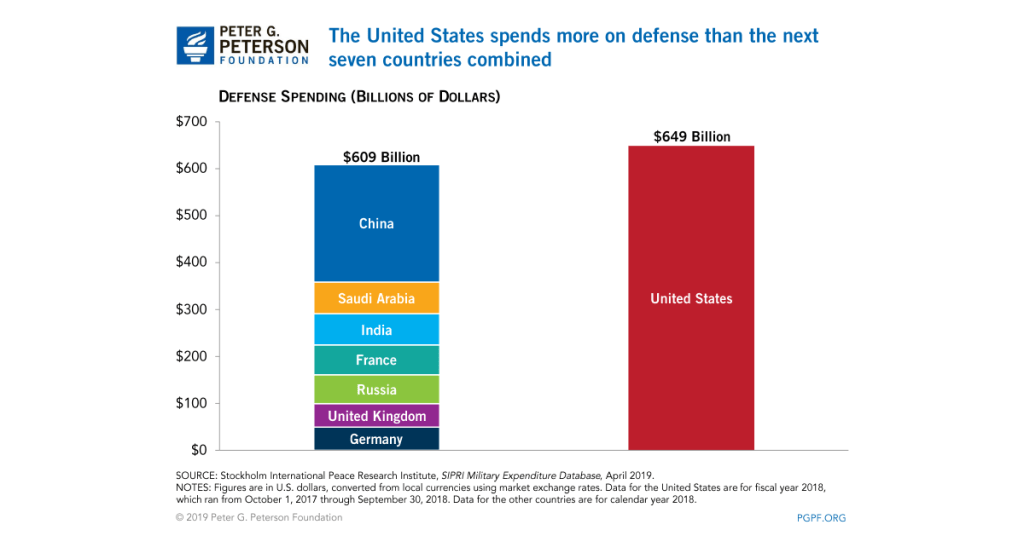
Dr. King was speaking to a culture in which violence was believed to be a necessary means for a desirable end. A place where it was “wise” to carry a gun “just in case” you have to use it. A country which had built the biggest military in the world (by a cartoon-ish amount). A country on a crooked path of disastrous means to meet the ends of a false security. I love the song “I won’t put my trust in chariots or horses” that our brother in Christ, Jonny Szczesniak, wrote because in it I believe he, like Dr. King, points to a path different from the common sense of this world. It’s inspired by Psalm 20 and subverts the idea that we need to out-violence anybody who would want to hurt or take from us. The song gets its chorus from verse 7: “some trust in chariots and others in horses, but we depend on the Lord our God.” It is glaringly obvious from the graphic below in which the United States is trusting.

Numbers are from 2017-18

Who should we follow?

C.S Lewis argued that when Jesus said “love your enemies” what he meant was to love them intellectually/emotionally, and that it was okay to kill somebody as long as you didn’t hate them in your heart while you did it. St. Augustine thought that war was sin, but he also thought it was the remedy to sin, as well. He believed that the only reason to go to war was the desire for peace.

On the contrary, the Apostle Paul said the way we wage war is different from how the world operates.

For though we live as human beings, we do not wage war according to human standards; for the weapons of our warfare are not human weapons, but are made powerful by God for tearing down strongholds. We tear down arguments and every arrogant obstacle that is raised up against the knowledge of God, and we take every thought captive to make it obey Christ.

2 Corinthians 10:3-5

Even though the bar seems to be set impossibly high, the Jesus way is to love our enemies. If somebody hits me in the face, the Jesus response is to not retaliate in kind, even if this means possibly accepting additional harm. The Jesus way is allowing my coat to be stolen and in response offering more in the hopes of finding reconciliation.

Jesus is God with us.

Often, a response to this approach  is “that doesn’t make sense.” Or “that’s beautiful but not practical.” Paul had similar detractors. To whom he wrote “the wisdom of the world is foolishness to [Jesus’s way]. The strength of [Jesus’s way] looks like weakness to the world.” 1 Corinthians 1:27

It may be helpful to consider the way in which anxiety fuels our doubt. It takes a lot of faith to sacrifice such a basic level of our need. It takes a lot of faith to push back against the fear of death and actually take up our crosses. God knows this. Jesus is inviting us into an ongoing process of being transformed. We need a community who will walk with us in following Jesus otherwise the call to non-violence may really be too high.

I think it’s our anxiety that makes Jesus’s way looks foolish. His words in Matthew 6 (right after he taught on loving our enemies) are about trust: “not a sparrow dies without your heavenly father knowing about it. How much more does he care for you?” “Do not worry,” he implores. Have faith. Trust the unusual power of the Spirit of Jesus with you.

It may seem distant and irrelevant, since a physical altercation may be rare and we may have never been robbed, but people in our community have and we can be there for them to support them as they follow Jesus. If we are to believe that Isaiah was correct in saying “God’s ways are higher than our ways”, then we should look at ourselves and our leaders and really strive to find this higher way. If we keep our personal political preferences in line with the wisdom of the world, then can we really claim to follow Jesus at all?

Jesus’s way is risky and scary but if there is any reason to celebrate Christmas and the New Humanity than it is worth considering how our insecurities can be met by “God with us.” Our truest Lover. 

By Robert Anstett 2020

The Ghosts of Jeju

My ascent up Mt. Hallasan was made slow by thick fog that hung heavy that day. As I carefully wove my way across the South Korean country roads that led to the Jeju April 3rd Peace Memorial, I had little idea of what I would find. The events that are commemorated there – which happened on the isle of Jeju between 1947 and 1954 – have been hidden in the fog of 20th century history, much like the fog obscured the roads I drove on that day.  When I first walked inside the memorial museum, the first exhibit I saw was a large, smooth, granite block – something that should be a historical marker, or perhaps a grave stone. Instead of a detailed explanation or an etched list of hallowed names … it was blank. This block, I learned, is a symbol for how the blood soaked events that occurred on Jeju some 70 years ago “lack historical definition”. Was this a simple uprising of concerned citizens, an insidious communist plot to keep the region destabilized, or perhaps something in between?

This blank stone slab rests at the entrance to the Jeju April 3rd Memorial Peace Museum. This historical marker has been left blank and represents the lack of “historical definition” given to the events that took place.

In reality, these events have been denied their definition by the powerful, by the “winners” who set the historical narrative by those with vested interest in silencing the Ghosts of Jeju. Should these ghosts be heard, they might force us to reexamine our history and commonly held beliefs. This writing is my attempt – as an American whose government contributed to those blood-soaked events – to cut through the fog and amplify the voices of the Ghosts who mourn on Mt. Hallasan. By hearing these voices, and the stories they share, we may learn to see our current conflicts with new eyes and proceed with caution when listening to the perpetual booming of those who would lead us towards war.

Old man of Jeju statues of Dol hareubangs are large rock statues found on Jeju Island  . They are considered to be gods offering both protection and fertility and were placed outside of gates for protection against demons travelling between realities.

Before we get into the series of events, which have become known as the “Jeju 4/3 Incident”, it will be helpful to know a bit of the geographical and historical context that led to the incident. Jeju is a province of the Republic of South Korea, an island off the south coast of the Korean Peninsula. A popular vacation destination for the rest of the country, it is known for its beautiful beaches, its tangerine farms, and Mt. Hallasan – the tallest mountain in the country. “Old Man of Jeju” statues dot its landscape and mark out its various tourist destinations. Though relatively small, it holds an abundance of culture and natural beauty.

Prior to the slaughter of the Jeju 4/3 Incident, Japanese rule of the area came to a close in 1945. The forced labor and cultural suppression imposed by the Japanese Empire had been brutal, and their defeat by the USA and USSR was a welcome turn of events for the people of Korea. Unfortunately, these would-be liberators were much more interested in geopolitical posturing and power politics than they were about the freedom and self-governance of the Korean people. It was decided that the country would be split. In the years that followed, US military rule was enforced at the expense of genuine grass roots movements for democracy – which had wide support both north and south of the 38th parallel. These movements wanted a united Korean Peninsula. Groups such as The Committee for the Preparation of Korean Independence were actively suppressed. Furthermore, officials who were formerly Japanese collaborators were often kept in power to enforce local law and order under US military rule. This lead to wide-spread discontent.

Despite this repression, political parties that called for Korean unity – such as the Jeju People’s Committee – remained incredibly popular and even functioned as a de facto government on the ground. Jeju’s historical involvement in the resistance against Japanese rule, as well as its tight-knit community culture, allowed  parties for true Korean independence to enjoy unusually high levels of support. Tensions were further pressurized by drought and the exploitation of former Japanese collaborators. The island was a matchbox ready to catch ablaze.

Art work from the Jeju April 3rd Peace Memorial Musesum

Local agitation came to a head on March 1st, 1947, when the people of Jeju gathered both to commemorate the past struggles against the Japanese and to peacefully protest the planned division of the Korean Peninsula. They correctly asserted that a divided Korea would lead to civil war. In preparation for these demonstrations, the US military regime had deployed 100 police to the island. During the demonstrations, a child was struck by a police horse; this turned a protest into a riot and the police fired on the unarmed protesters – killing six, including a woman holding her baby. The police claimed they fired in self defense and proceeded to round up protesters after the event. This day began a cycle of repression and resistance that would leave close to 30,000 islanders dead by its horrible conclusion.

As the number of arrests reached into the hundreds, a general strike broke out across the island. As arrests mounted, rumors of torture and inhumane jail conditions spread among the people.  On April 3, 1948, the civilians of Jeju began a violent revolt where over half of the police stations on the island were forcefully taken over and 14 officers were killed. In response to the revolt, the US military regime labeled Jeju a “Red Island” and sought to impose martial law. One US colonel declared, “I don’t care about the causes. My mission is only to crack down.” Violence further escalated when the entire central region of the island was deemed illegal. Entire villages were forcefully relocated – and in some instances, slaughtered. Anyone found in the illegal zones was shot without question or regard for their personal circumstances.

As the new South Korean military regime cracked down with the
backing of the USA, the number of dead increased.

These measures eventually broke the back of the resistance, and they became just a prequel to the extreme violence and bloodshed of the Korean Civil War – an event which the people of Jeju had predicted and hoped, in vain, to stop.  In the end, 10% of the total population of Jeju was murdered; another 10% was forced to flee to Japan or other neighboring areas. Those who were left began to rebuild, but many of the abandoned villages remain vacant and ghostly to this day.

In the aftermath of the Jeju 4/3 Incident, it became illegal to speak of what happened. Those who dared speak the truth in the Republic of South Korea were silenced by the military regimes which had taken power after the Korean Civil War. In the United States, we continued to live our lives largely ignorant of the crimes that were committed in our name. Only after the democratization of South Korea in 1987 did the taboo of discussing the Jeju 4/3 Incident begin to dissolve. In 2006, the South Korean government officially apologized for its role in the massacres. The United States government, to my knowledge, has never commented on its role.

Image of a protester occupying the space where a US Navy base is to be build taken from “Gureombi, The Wind is Blowing”. This Documentary is now free on Youtube.

As an American, learning about these events troubled my soul. It was hard for me to look Koreans in the eye while visiting the Jeju April 3rd Peace Memorial . This shame I feel has motivated me to share this story with you; I hope it helps you look further into the events in Jeju as well as other similar events the US has precipitated around the world. Jeju’s resistance to US imperialism continues to this day with the heavy resistance to the building of the Jeju Civilian-Military Complex Port – a naval base designed to enforce the United States’ hegemony over the region in defiance of China’s expansion. Again, Jeju finds itself as a chess piece in the United States’ geopolitical conflicts. The conflict around the building of this base is documented in the film “Gureombi, The Wind is Blowing” which is linked here. As a citizen of the US, I feel it is vital that we adopt a more thoughtful and non-fear-centered approach to how we utilize our global power. It would be an unspeakable tragedy to continue the mistakes of the last century, and those who can, need to stand up for the new future they want to create. The key to breaking the patterns of the past may be found in the voices of the ghosts of Jeju.

Introduce Yourself (Example Post)

This is an example post, originally published as part of Blogging University. Enroll in one of our ten programs, and start your blog right.

You’re going to publish a post today. Don’t worry about how your blog looks. Don’t worry if you haven’t given it a name yet, or you’re feeling overwhelmed. Just click the “New Post” button, and tell us why you’re here.

Why do this?

  • Because it gives new readers context. What are you about? Why should they read your blog?
  • Because it will help you focus you own ideas about your blog and what you’d like to do with it.

The post can be short or long, a personal intro to your life or a bloggy mission statement, a manifesto for the future or a simple outline of your the types of things you hope to publish.

To help you get started, here are a few questions:

  • Why are you blogging publicly, rather than keeping a personal journal?
  • What topics do you think you’ll write about?
  • Who would you love to connect with via your blog?
  • If you blog successfully throughout the next year, what would you hope to have accomplished?

You’re not locked into any of this; one of the wonderful things about blogs is how they constantly evolve as we learn, grow, and interact with one another — but it’s good to know where and why you started, and articulating your goals may just give you a few other post ideas.

Can’t think how to get started? Just write the first thing that pops into your head. Anne Lamott, author of a book on writing we love, says that you need to give yourself permission to write a “crappy first draft”. Anne makes a great point — just start writing, and worry about editing it later.

When you’re ready to publish, give your post three to five tags that describe your blog’s focus — writing, photography, fiction, parenting, food, cars, movies, sports, whatever. These tags will help others who care about your topics find you in the Reader. Make sure one of the tags is “zerotohero,” so other new bloggers can find you, too.

Design a site like this with WordPress.com
Get started