Be yourself; Everyone else is already taken.
— Oscar Wilde.
This is the first post on my new blog. I’m just getting this new blog going, so stay tuned for more. Subscribe below to get notified when I post new updates.
Be yourself; Everyone else is already taken.
— Oscar Wilde.
This is the first post on my new blog. I’m just getting this new blog going, so stay tuned for more. Subscribe below to get notified when I post new updates.

(This writing was originally a talk given at Circle of Hope’s South Broad congregation)
So, the line I am here to talk about is.
“Blessed are the Peacemakers, for they shall be called the Children of God.”
Before I really dive into that, I wanted to introduce myself and give a little bit of background on why I would be the one to talk about this. My name is Rand Williamson. I use he/him pronouns. I’ve been a member of Circle of Hope for a while now, and for a little over two years of that time I led a compassion team at Circle of Hope called Circle of Peacemakers. Also, it wasn’t just any two years but it happened to line up pretty nicely with the beginning of the pandemic, the George Floyde protests and everything else that came along with that. It was an intense time to really dive into what it meant to be a peacemaker. In that time we organized talks and teach-ins on important issues, we went to protests, were attacked at one of those protests, and participated in acts of civil disobedience by cleaning and spending time in the homeless encampments that were on the parkway. When I heard that we would be taking a Sunday to talk about Peacemakers and how they are blessed, I thought it would be on brand for me to speak up. Peacemaking is something I have invested a lot into, not just in the past two years but throughout my adult life.
Having said that, I started doing this work when I was younger because of the example of those who came before me. Peacemaking is part of a long tradition in the Church. The message of Peacemakers is the same now as it was since the days the disciples walked the earth. I had no part in creating it, so I would be wrong if I didn’t mention my mentor and teacher Paul Clark back in Reading, or his mentors Phil and Dan Berrigan, or the nameless multitude of saints whose shoulders we all stand on. They carried that message to me and I hope to carry it to those after me. The message, put simply, is this. The same God who created heaven and earth also created you. Furthermore, they love you and have imbued human life, your life, with a sacred dignity that demands to be recognized. When it is wasted, it “cries out for justice. That is what God said to Cain after he murdered his brother Able, that Ables blood was calling out to him from the Earth. Recognizing that sacred dignity, and bearing witness to that calling out is a large part of being a peacemaker, but I want to talk more about specifically what a peacemaker does later on.
“Blessed are the Peacemakers, for they shall be called the Children of God”
The first thing that came to my mind when I started meditating on this line from the beatitudes is that, like Rachel has pointed out about other parts of the beatitudes, this is actually pointing to a reality that already exists. We are all already the Children of God. Paul puts it well in Romans chapter 8. He says
“For you did not receive a spirt of slavery that returns you to fear, but you received the spirit of sonship, by whom we cry “Abba! Father!” The spirit himself testifies with our spirit that we are God’s children. And if we are children, then we are heirs: heirs of God and co-heirs with Christ”
So, we already exist in a state of being the Children of God. We are the heirs of God’s Kingdom. Again, we have God’s love and the inherent sacred dignity that God infused into us at the time of our creation. So is there anything actually special about this designation of “Peacemaker”? I would say yes, but not in an essential way. What I mean by that is that being a peacemaker doesn’t change anything fundamental about our relationship to God or creation. That is not why we undertake the work of peace. Rather, we take on the work of making peace so that we may more fully live into, and outwardly realize, the relationship with God that already exists.The work of peacemaking is how we make our heirship apparent to those in the world around us. It is how we can shine the light of God’s love and reveal the dignity of human life to those with the eyes to see it and accept it.
When I think of an example of what it means to be a Peacemaker, I think of the archetypal Peacemaker, the first Christian Peacemaker anyway, as John the Baptist. When people asked him who he was, he quoted the prophet Isaiah. He said he was there to “make straight the way for the lord”. He was there to lift up the valleys and smooth out the mountains and reveal the truth that God had already set in motion. John was preparing people’s hearts and minds for the coming of Christ. The more I think about what it means to be a peacemaker, the more I have come to see that work as a continuation of what John the Baptist started. He prepared humanity to receive the revelation of Christ. As peacemakers today, we are calling people to live more fully and outwardly into that revelation. Because of John the Baptist’s position as this archetypal peacemaker, I think it is a good idea to more closely study him and see what we can learn about how he carried himself through life. From this study, we can derive some principles that will be helpful in our own work. I’ll spend the rest of my speaking time going over three aspects of John the Baptist that I think especially equipped him for his life’s mission.
Fighting for Peace
The first thing I think John teaches us is that to be a peacemaker, you have to be able and willing to fight. Not in the sense of beating people up, but you cannot be scared of confrontation or controversy. John the Baptist, in his life, definitely wasn’t scared of either of these things. He was a martyr. He was arrested and eventually killed for calling out a powerful individual, Herod, on his weird incestuous tendencies. So John was willing to call out those in power, even when it put him at risk.
I wanted to bring this up first because I feel, and especially in Church related groups, there has been a pretty prevalent tendency to confuse keeping the peace with making a just peace. A just peace is a peace built on a foundation of the things I talked about earlier. It’s built on love and the recognition of the inherent dignity due to life. What we usually experience in the world is peace in a sense, it is the absence of conflict, but usually it is built on submission that is coerced through force. Outwardly, a state of submission can sometimes resemble peace for at least short periods of time. This idea has been played around with in popular culture recently. There is a show that just came out called The Peacemaker and it stars John Cena. He dresses up in a superhero outfit with a dove on it. He “makes peace” by going out and shooting people in the head. He creates peace through force of strength. That is something Herod probably could relate to. You know, maybe sleeping with your brother’s wife and getting aroused by your niece isn’t a problem if you kill everyone who criticizes you for doing it. The silence and the submission allow one to fool themselves into thinking that nothing is wrong.
If you aren’t bumping directly into the armed “peacemaking” forces of the state. It is actually pretty easy to be fooled by this state of submission. It can be pretty comfortable, we haven’t known anything else for the most part, and there is the illusion of safety if you don’t struggle. It can functionally become invisible, and once it does that it might even be possible to confuse people who point out problems as being the problem themselves. I think this principle has played out in discourse around Critical Race Theory as of late. We see, in the last few years, a real reckoning with the effects of racism and the legacy of the racist history of our country. On the other hand, we see the rise of this urge to label those pointing out this history as “the real racists”. The disrupters of the quiet submissive state we are used to are equated with disrupting “the peace”, and it is easier for us to try to revert to that submission then to move forward into the solution to the real violence. So, we see this concerted effort to cover up the issue under the guise of pushing back against this scary academic term “Critical Race Theory”.
I talk about the critical race theory issue because it stands out right now in popular discourse, but I think we, in our own community, can often employ tactics like this that are a bit more subtle. One thing I have seen done more than once is the distortion of popular ideas in our faith, the concept of the third way stands out, into purity tests that allow us to quickly wash our hands of people we think are in bad taste. In the Circle of Peacemakers work with the homeless camps in 2020, I saw this play out. Homelessness and poverty is a terrible violence on the human spirit, it changes a person, and not in pretty ways. Because of this, a lot of people in those camps were not what we would call conventionally “nice people”. They had serious problems, and that was used against them by the city. Some people in Circle bought into this. This, however, is the same error we see in the discourse around Critical Race theory. The real violence is in the state of homelessness. By gathering to make themselves more visible, these brave people pointed us towards the real problem. Their disruption, through the occupation of the Parkway, was not the core problem.
At the end of the day, it can be a really hard line to walk, but living into the new creation made available by Christ requires a rejection of the old world. The new world stands in confrontation to the old. As the new world increases, the old shrinks and breaks apart. To be peacemakers, we have to be willing to be a part of this confrontation. That means challenging systems of power in a way that sometimes offend our sensibilities that are rooted in our identification with the old way of being. We don’t do this explicitly for the sake of offense, but because these confrontations and the discomfort they cause can serve as catalysts for real redemptive change. They can move us closer to living into our heirship.
Willingness to Repent
I’m already starting to touch on the next thing I wanted to talk about. This is our own identification with the old world. It is very tempting to just call out explicit power players like Herod, or perhaps the leader of whatever political party we happen not to like. Surely, they deserve some scorn for being direct administrators of corrupt systems, but we also have to scrutinize ourselves or we might fall into the trap of recreating the type of world we were trying to get away from. Bad leaders do not actually stand on their own, they are propped up by bad systems, and those systems are made of the people. They are made of us. We grow up in these systems of social relations. They define us and shape who we are. Part of the real tragedy of our predicament as humans is that we do not have to exert effort to recreate what already exists. It has its own momentum and it carries us with it. It’s kind of what is touched on in movies like The Matrix. Power systems, when functioning properly, can be pretty much invisible. It’s when we appear to be outside of them, when we think that we have escaped, that we are in the most danger. They don’t just order our external world, but they order our internal desires as well. If we just follow our spontaneous sense of well being, we may never bump into the edges of the matrix. It won’t lead to real freedom. We have to work to be free.
Even acts that seem to be rebellious outwardly can, in fact, reveal our complacency and acceptance of the current system’s values. Riots, for example, often show us this. A riot seems like a great disruption, and they arise out of legitimate frustration at the status quo. They often, however, don’t target the status quo or its administrators. Instead, they devolve into looting and the taking of consumer products. These products convey status and legitimacy in our current system, and not being able to have them conveys a lack of legitimacy. The impulse for looting then makes sense on some level, but it is not a rejection of the values which have caused the violence and disenfranchisement. Rather, it is an act that shows our acceptance of those values and our desire to gain more status in the current system.
John built his life around separating himself from the values of his time. A huge component of what John did when he was preparing the way for Christ was to promote self reflection and repentance. That was actually a necessary part of being in his movement. Also, John explicitly did not work within city’s. He took great pains to avoid living within the system of social relationships of his time. He absolutely cut himself off from them and reverted back into a hunter-gather style of living.
Why would John feel that it was necessary to cut himself off from society in such a profound and total way? At the time John lived, he lived in an Israel that was subject to occupation by the imperial forces of Rome. It lived in a state of desperate submission and its wealth and resources were being extracted to feed the Roman war machine. The cultural leaders of the time, the Pharisees, had pretty much acclimated to the situation and off loaded a majority of the burden onto the poor peasants of the time. They hid behind their special status and tried to placate others with platitudes about their history and special place as the people of God. John rejected this plainly when he pointed out to them that “out of these stones God can raise up children for Abraham”. On the other hand, there was a continuous and growing movement pushing for a revival of Jewish identity through direct military conflict with the Roman empire. While this camp had more self-respect, both popular options for the people of Israel amounted to a form of suicide. John needed to separate himself from both in order to work out a third way with his followers.
I’m not saying we need to move into the wilderness like John. John’s situation was pretty exceptional because it dealt with the revealing of Christ and the fulfillment of prophecy. Jesus later took what John was building and brought it back into the larger society. Since we still have Jesus with us, I think we can feel safe doing this work within society as well. We do, however, need to be able to look at ourselves and self critique. Not just for the sake of some impulse to self flagellate, but to actually make ourselves better. Improvement through repentance is within our capabilities. We don’t have to be 100% pure to engage in this work, we don’t have to let the perfect be the enemy of the good. Additionally, we should take seriously criticisms that are offered to us by others in our community. We don’t have to accept everything that is said of us. We have to discern whether criticisms are being offered in good faith, but it is often the case that our flaws are so close to us that we can’t easily see them. It is helpful to have an extra set of eyes that you can trust.
Humbleness
In fact, this is a good time to pivot into the last principle, derived from John, that I want to talk about today: humility. All of this Peacemaking work is community building work, it’s liberating because we can transcend our limits as individuals when we enter into something larger than ourselves. This movement to fulfill all righteousness, to live into the kingdom of God, has existed for as long as humans have. We are an incredibly small part of it, and we should allow the massiveness of this movement to humble us. Even if we become capable and effective spreaders of the message, like John the Baptist was, we have to admit that we aren’t the ones who created this message. We simply do our part to carry that message on.
I said earlier that John is the first Christian Peacemaker because of his proximity to Christ, but he was already a part of a long project of building from the Hebrew Prophets. He positioned himself in that tradition by quoting Isaiah, and then Jesus also put himself in that tradition by being baptized by John. John was one of the most effective leaders in the history of our faith. He was so loved by people at the time, that they compared him to Elijah. As soon as Jesus appeared, however, he was willing to step aside. He had absolutely no ego about this. He knew what role he had to play, and when he had played that role, he stepped aside so that even greater things could happen.
In organizing work, that is often the way things go. We do not really control when or where movements happen. A community can work in obscurity for years or even decades, and then some kind of hinge point occurs. The usually invisible systems of power become visible and people take to the streets. I have been lucky enough to live through more than one of these events. They are massively meaningful events, but also they can be massively frustrating. They rarely ever occur how you would like, and organizing people can be like herding cats. To really embrace and use these moments, we need to balance like John. We need to be able to stand firmly on our foundations and at the same time sway with the people. We need to be able to meet them where they are at, and if something new develops, we have to be willing to plug into it even if it wasn’t our idea.
I think this kind of humility is especially important in our present moment. A lot of the ideas and assumptions that previously guided our actions in the world now seem to be fraying at the seams. In America, and in the church here, we really don’t have an agreed upon narrative about who we are and we are increasingly polarized. This is something that comes from contradictions in the larger society, but it is in the church. Last year and this year we have suffered a great deal because of it. The pandemic lock downs also add to this sense of atomization. I don’t think we can escape it, but one thing we can do to keep it from destroying us is to adapt some of John’s humility. We need to acknowledge that the old consensus has fallen apart because it was inadequate. It failed. As we try to construct something new out of this failed consensus, we have to consider that we are not entitled to anyone agreeing with us. In Circle of Hope, we are fortunate that we don’t have a system in place to force us to think in just one way. We can have disagreements and that doesn’t mean we have to leave the church, and yet people do leave. I have to assume this is out of a sincere hurt that stems from a lack of agreement where agreement used to exist or where it was just assumed. I do find this very unfortunate, but at the same time, if I am being honest, the situation doesn’t engender much sympathy from me. It seems like too much of an unnecessary waste for me not to feel disdain for it. We talk a lot about dialogue, and in just a few moments we are going to have some dialogue where you might say you didn’t like some of the things I said during this talk. I hope you feel comfortable enough to do so. Confronting and working out differences is challenging but I think that is the best way forward. We are coming up on Lent, which is historically, a time of reconciliation in the Church. I pray that we can really embrace that this year and repair some of the relationships that have been lost. God, please soften our hearts.
Conclusion
We live in a pretty troubling time. The systems of power that used to function in obscurity have been exposed by the strain of the pandemic. Increasingly, it is becoming undeniable in people’s minds that something is deeply wrong. We see disasters and crises mounting one after another. There doesn’t seem to really be an answer for any of them.Our leaders and institutions are just as trapped in the momentum of “progress” and modern society as we are, it is not clear who, if anyone, is at the wheel. We live in a pretty troubling time, but there is hope. It is promised to us by God Being a peacemaker is about finding and lifting up that hope. If we can do that, are status as Children of God will be made obvious to all.
We have to start really taking account of what it means to live into our heirship as children of God in this current age. With humility, we need to be willing to analyze and confront the mounting problems of this world. Not as super stressed out individuals with savior complexes trying to take the weight of the world on their shoulders, but as committed members of a community with life affirming values. We need to conduct ourselves as peacemakers. Jesus gives us insight into the power of love and life. How can we embrace this and present it in a way that will remind people of their true worth?
I will be looking for these answers in earnest with the Circle of Peace Makers, we will be meeting Saturday March 19th at 11 to begin putting these principles I laid out from John into practice. I hope you can join us! There are lots of ways to plug into this missional work at Circle of Hope, let’s build something beautiful together.

The Looming Conflict
In recent weeks, a lot of media attention has been dedicated to the continually escalating stand off between countries aligned with NATO and Russia. The dispute arises out of a number of issues, but prime among these is the possible inclusion of Ukraine into NATO as a member state. Russia, for reasons we will talk about later, sees the expansion of NATO as a threat to its national security. On the other hand, Russian interventions in the region to prevent Ukraine from entering this military alliance are seen as violations of Ukraine’s national sovereignty. This has led to an impasse. Russia has amassed troops along its border with Ukraine, and NATO countries have responded by flooding the region with weapons and threatening sanctions. The U.S. alone has sent 200 million dollars in what it calls “lethal aid”.
Right now, there are negotiations scheduled over the next couple weeks. Additionally, there are talks scheduled between the Ukrainian Government and Russian seperatist groups next month. This seems to indicate that, at least in the immediate future, war is not yet upon us. It is not clear, however, how effective these talks can be given the two sides’ diametrically opposed positions regarding Ukraine. The poker face/mind games element of these negotiations, and the general incoherence of NATO member countries further complicate any analysis of what direction we are currently heading in. Taking this into consideration, this essay will not speculate on possible outcomes. Rather, it hopes to provide information to Americans who are still concerned with peace, and to encourage deep thinking on this matter. Any conflict between nuclear armed states is a potentially existential threat to the entire human race. Peacemakers in America have to step up to highlight this fact and provide a counter narrative that makes our government’s role in this escalation controversial. Hopefully, this essay can play some small part in shaping how the reader views this conflict.
There Is Cause For Caution With NATO
The North Atlantic Treaty Organization, or NATO, was formed in the aftermath of world war two at the start of the Cold War. NATO’s own website identifies three reasons for its formation:deterring Soviet expansionism, forbidding the revival of nationalist militarism in Europe through a strong North American presence on the continent, and encouraging European political integration. At its inception, it is a military alliance with an antagonistic and oppositional position towards Russia, and while Russia no longer is the Soviet Union, the basic character of its relationship with NATO is at least perceived to be the same. This may be in part due to NATO’s continued expansion to the east despite assurances made by the US Government that NATO would not expand after the Cold War came to an end.
There is a saying that “the best defense is a good offense” and, despite usually selling itself as a defensive/deterrence based alliance, this wisdom is not lost on the US and its NATO allies. In its history, it has taken offensive actions on behalf of the interests of its member states. One of its more infamous actions was the air bombing campaign it launched against the former Yugoslavia in the 90’s This campaign, carried out in support of a Kosovo independence movement, resulted in massive collateral damage and civilian casualties.It was unquestionably illegal based on international law. Additionally, Kosovo still remains in limbo regarding international recognition to this day. This should give us pause when considering if NATO is really the kind of organization that can support Ukraine in this crisis.
No Peace without Peacemakers
People of conscience within the US should not be fooled. The USA, and by extension NATO, are not in the game of global dominance for altruistic reasons and their interests have very little to do with the interests of most Americans. While rhetoric about human rights and state sovereignty is often on the lips of our leaders, these concerns always take a back seat to business as usual. President Biden, in a move that even upset other senate democrats, recently made an arms deal to the authoritarian and anti democratic government of Egypt. Strange given our declared stance of being against authoritarianism around the globe. At the end of the day, the ‘rules based international order’ often touted by our government is a system of law built on a foundation of lawlessness. The United States disregarding the laws and practices it demands of others, and looking the other way when its allies commit crimes, is a keystone of its functioning. This kind of exceptionalism is incompatible with a sustainable, just global order.
This is not to say that we must turn a blind eye to the crimes committed by Russia. If we seek to avoid the hypocrisy of our leaders, we must speak out on this too. At the same time, we cannot allow the propaganda and narratives of the state department to convince us that Russia, or any geo-political rival of ours, is uniquely and irredeemably villainous. We cannot accept that a war launched on foreign soil can be moral or humane on any grounds. It is not cowardice in the face of injustice which fuels opposition to war, but a love of justice, and a belief in humanity. Our government should stop using Ukraine as a geo-political chess piece and encourage its integration into Europe through non-military trade alliances.
As it stands now, however, what our own government does with this situation is completely out of our control. The bloated budget of the military is one of the few things both relevant parties in our government agree on. Military actions are now largely outside of the direct control of our democracy, and worse yet, the situation has been normalized and many are numb to it. Voices for peace have been utterly marginalized. It truly is worth lamenting how much building needs to be done, but this building has to start with a core of people who are willing to loudly push back against the state’s ‘reasonable’ arguments for war. People who are willing to talk to their communities and stir controversy around these issues. We cannot shy away from conflict in our pursuit of a more just and nonviolent world. There will be no peace without peacemakers.

A Return to Normalcy?
Anxiety and hope, these days, seem to be the closest of friends. Last week, after being quickly shuffled from station to station, I found myself seated in a quiet waiting area so that I could be observed for fifteen minutes after receiving the first dose of my COVID-19 vaccination. Luckily, I didn’t experience any serious adverse reactions and I was free to go shortly after. As I walked out, it felt good to get the process started, but the wait for the second dose has since become tedious. In many areas of my life, I feel as though I have now come up to a corner, an exit from the forced hibernation of 2020. It is so close, and yet I cannot turn that corner. It is still several weeks away. Even worse, while I do sincerely want to turn that corner, a large part of me is also sincerely scared and worried about what is on the other side. This, from talking to friends and family, seems to be a common sentiment. This mix of hope and fear seems to be a significant part of our nation’s current zeitgeist. With the political defeat of Donald Trump and the development of COVID-19 vaccines, we start to see the much longed for return to normalcy which has been promised by our leaders, but many are hounded by the sneaking suspicion that there may be no normalcy to return to. Worse still, as we start this race back to “normalcy”, it seems that some of the worst aspects of American life are the first out of the gate.
Domestically, this means the return of mass gun violence and killings carried out by lone actors on a weekly basis. It is, honestly, hard to keep count of how often these mass shootings now occur. These killings happen in parallel with a seemingly never ending stream of footage showing new extrajudicial executions of American citizens at the hands of the police. A societal ill which, like most, disproportionately affects our black and brown brothers and sisters. It seems one of the few things that could not be put on hiatus during the pandemic was the racism and bias baked into our society and its political economy.
This racism is not just baked into our domestic practices, but also historically has influenced our forgine policy. We live in a global society where the history of colonization of the world by, typically, Western European powers still carries weight. In America, we still benefit immensely from the wealth and power concentration that European military domination created over the course of hundreds of years. In many ways, we in America are the true torch carriers of that legacy of empire and western hegemony. It is for that reason that Christian peacemakers like myself find talk of America’s “return to the world stage”, another marker of our return to normalcy, more troubling than hopeful. In this essay, I hope to explore the implications of this return through a brief look at the history of America’s interventions in Asia leading up to the current geopolitical situation. It is my hope that, through this essay and subsequent dialog, a substantive and Jesus centered movement for peace, which challenges hegemony and imperialism can start to be built within the Church. Projects like these are of dire importance to an American Church wrestling with its increasing irrelevance in the minds of the country’s younger generations.
Asian Hate and America: A brief history of America’s Actions in Eastern Asia.
If we want to talk about the history of American military intervention, it would be impossible to do so without considering its role in Asia in the last century. In fact, it is not an accident that I plan to publish this essay this week. This Friday, April 30th, marks the 46th anniversary of the end of the Vietnam War. A conflict started through manipulation and distortion, which claimed millions of lives. Behind the numbers, the trauma and pain caused by this conflict alone is incalculable. At our last Circle of Peacemakers meeting, we shared this video interview of a woman who survived America’s bombing campaign. Such testimony can start to provide a glimpse of the true magnitude of what happened in Vietnam.

Our involvement, of course, did not start in Vietnam.Just a decade earlier, the USA had helped, along with the USSR, to instigate another brutal civil war through the partition of the Korean Peninsula. The policy of partition was immensely unpopular among the Korean population and required the brutal suppression of the population across the country to pull off. This partition, as predicted, led to a civil war which entered into a ceasefire in 1953. At the start of the ceasefire, the civil war is still unresolved to this day, nearly 5 million were dead, over half of that number were civilians. Both the north and south lived under military dictatorship until, in the 80’s, popular movements for democracy were finally successful within the south of the peninsula. A look at the history of the struggle for South Korean democracy through the music of the pro democracy movement can be found here.
Unfortunately, it would be impossible to be exhaustive in covering the atrocities carried out by the USA in Asia over history. Between accounting for the direct invasions like those that took place in the Philippines, and the material support for bad actors like the Khmer Rouge, and actions like the strategically unnecessary nuclear bombing of Japan, there is just too much to cover. Of course, America’s interventions are also not just limited to Asia, but I wanted to highlight this region specifically for two main reasons: America’s increasing number of anti-asian hate crimes, and its increasing preoccupation with the containment of China, which it sees as a threat to its global influence. I believe these two trends cannot be fully understood separate from each other or the history which is briefly highlighted above.

Given that generation after generation of American men have been drafted and subsequently trained to dehumanize and kill Asian populations overseas, can it be any surprise that, at home, this country has a problem with violence against those of Asian descent? Rather than being an anomaly, the subjugation of those of Asian descent has been a key feature of our country’s development since at least the early 20th century. Our current domestic problems with violence against groups of Asians is a reflection of that. It is a societal demon that was all too easy to stir in the paranoid climate created by COVID-19 and decades of propaganda which has essentialized many Asian Countries as bad. Unfortunately, this barrage of propaganda continues to this day.
America, China, and the Paradox of the Jealous Husband
In fact, propaganda designed to essentialize and spread fear of the other has never been more widespread and sophisticated, and in a manner consistent with the history highlighted above, another formerly colonized country of Asia is the target. On any given day, one can open any major media publication and find at least one article highlighting the authoritarianism and social ills of China under the CCP. Despite our countries close economic ties, there is a vested interest in China’s demonization that transcends political administrations and the liberal conservative cultural divide in our country. These articles usually seek to highlight elements of Xi Jinping’s leadership, such as the lack of term limits lack of term limits for his position, shady business dealings on the part of Chinese companies, and more recently, their history of human rights violations, especially relating to the Uyghurs in China’s Xinjiang province. These tactics, especially the tendency to focus narratives on powerful forgine leaders and human rights abuses have become commonplace in the west since the end of the Cold War. It has been noted by scholars such Jean Brickmont in his book, “Humanitarian Imperialism”. To quote Brickmont:
“The ideology of our times, at least when it comes to legitimizing war, is no longer Christianity, nor Kipling’s “white man’s burden” or the “civilizing mission” of the French Republic, but is a certain discourse on human rights and democracy, mixed in with a particular representation of the second World War.”
Brickmont goes on to explain how leaders and regimes around the world are portrayed as “little Hitlers” in order to draw connections to the popularly perceived glory and moral legitimacy of our interventions to liberate Europe from the Nazi’s. As a propaganda tactic, it works to silence pacifists by portraying non-interventionism as immoral and cowardly. To negotiate and peacefully work out problems with these leaders, would be like trying to negotiate with Hitler, which most moral individuals of the west would see as ridiculous. Nevermind our own vast and ever growing history of human rights abuses both domestically and abroad.

Of course, in its attempts to characterize other nations in this way, the USA has a history of playing fast and loose with the truth. We have already mentioned how the Vietnam War was partly justified based on a distortion of true events. Unverified testimony from bad faith actors was used in the run up to both the Gulf War and Operation Iraqi Freedom because it was convenient at the time. More recently, unverified claims and eventually contradicted claims were levied against Venezuela when tensions between them and the USA was at its highest. Unverified or exaggerated claims play a role in justifying all these conflicts, but when these conflicts were happening, these testimonies were uncritically put forth as the truth.
In the present, with the current accusations against the CCP, there are certainly some issues with the sources which we use to justify our government’s claims of genocide. Especially in the work of Adrien Zenz who, based on my own reading, bases his claims on cherry picked quotes from CCP websites and “anonymous testimony”. Conservative think tanks that publish his work, such as the Jamestown Foundation were founded by members of US intelligence agencies and are still staffed by former National Security Advisors, Deputy Assistant Secretaries of Defense, and one individual who “acted as an architect of US-China strategy while serving in the Trump administration’s National Security Council”. That being said, getting a lot of information about Xinjiang province is hard. I have been studying the topic for over a month now and still cannot penetrate the surface. Both US and CCP sources are rife with conflicts of interest because no neutral, authoritative arbiter exists. Given the CCP’s known history with human rights, it is highly possible there is political repression happening in Xinjiang even if it does not reach the level of genocide like the USA and its hegemonic allies claim. At any rate, focusing conversation on the ills of Chinese society under the CCP, true or not, is exactly the aim of the program of humanitarian imperialism. The problem of humanitarian imperialism does not stem from whether the claims made in its name are true or not, rather its true insidiousness lies in how it creates a smoke screen, a pleasant humanitarian mask, for policies that are ultimately driven by hegemonic self interest.
In many ways, the situation with the USA and its claims resembles a thought experiment called the Problem of the Jealous Husband which was originally put forth by psychoanalyst Jecques Lacan. This paradox is explained well by philosopher Slavoj Zizek in his essay, “Jaque Lacan’s Four Discourses”.
“Recall, again, Lacan’s outrageous statements that, even if what a jealous husband claims about his wife (that she sleeps around with other men) is all true, his jealousy is still pathological. Along the same lines, one could say that, even if most of the Nazi claims about the Jews were true (they exploit Germans, they seduce German girls), their anti-Semitism would still be (and was) pathological – because it represses the true reason the Nazis needed anti-Semitism in order to sustain their ideological position.”
Much like the jealous husband of Lacan, or the Nazi in Zizek’s explaination, the United States’s constant accusations of crimes and abuses by its enemies are not what they appear to be at the surface level. The accusations, even if true, are not about the human rights abuses that they call out. The accusations are ends in themselves, a necessary part of how the United States Government and its hegemonic allies justify their role as chief power brokers in the global society they have created. The accusations “sustain their ideological position”. This is a position that they, perhaps rightfully, fear is being increasingly challenged by the influence of China under the CCP.

A recent meeting between officials of the two superpowers took place in Anchorage Alaska. The situation quickly became heated as the officials exchanged accusations with their opening remarks. A Chinese delegate, Yang Jiechi, said of the current ‘rules-based’ global order “the problem is that the United States has exercised long-arm jurisdiction and suppression and overstretched the national security through the use of force or financial hegemony.”. Beyond these statements, China has been forming large, region changing, deals with other powers in opposition to US Global policy and is moving full steam ahead with its Belt and Road international infrastructure initiative which has the potential to “usher in a new era of trade and growth for economies in Asia and beyond.”. The message is clear, China no longer sees itself as a second rate world power. As China continues to make moves to solidify what it understands to be its new role, we should expect an increased number of accusations of increasing intensity from the USA and its allies.
The Role of US Peacemakers: Choosing the Good over the Exceptional
In short, we find ourselves entering into a new geopolitical climate. As the old unipolar power structure begins to slip, new poles and centers of power emerge. The rise and fall of empires seems to be as natural and unstoppable as the rotation of the globe itself. While it is unlikely that the United States as a world power will be going anywhere soon, it is becoming increasingly important that we in the United States begin to consider what a redefinition of our role in the world might look like. In this new climate, it is no longer enough to make vague claims like “we need peacemakers at decision making tables”. We need to formulate what, as peacemakers, we exactly intend to say if and when we can secure that seat. Helping to facilitate the needed redefinition may be an avenue through which we can have great impact. The potential costs for failure and the potential rewards for success are both astronomically high.
As just the snippet of history presented earlier in this essay demonstrates, the history of the 20th century and the Cold War in which the USA emerged overall victorious, was a story of brutality and bloodshed. Where this bloodshed was concentrated, whose bodies were used as the foundation of the power centers which emerged, was largely determined by what came before: the racist Eurocentric legacy of colonization. As we struggle to dispel that racist legacy, a co-occuring commitment to maintenance of the old hegemony will inevitably become a roadblock to that process. The recent rise in tensions against China along with the steady increase of attacks on those of Asian descent in America hints at this connection. The connection between imperialist expansion and the material and spiritual rot of the imperial center has been observed by many.

Beyond its intersectional effects on social problems in the USA, the unquestioned maintenance of imperialism could result in catastrophe and the destruction of our civilization. During the last Cold War of the 20th century, there were many times where the use of nuclear weapons were just barely avoided. With the additional strain of climate change looming ever closer in the 21st century, can we afford to live in a world with superpowers diametrically opposed to one another? As this is being written, the Bulletin of the Atomic Scientists, a long standing group of experts who have been acting as watch dogs to ‘reduce man-made threats to our existence’, has placed their doomsday clock at 100 seconds to midnight. This insight should give us pause. Every act of calculated brinkmanship engaged in by our military around the world could lead to untold disaster.
Anxiety and hope, these days, seem to be the closest of friends. On an individual, societal, and global scale, we seem poised to turn a corner into a new, and potentially frightening, tomorrow. While our troubles are great and the sins of our history we still carry are heavy, as a Christian committed to the prophetic peacemaking tradition of my faith, I believe that every corner we turn provides an opportunity for our redemption. Not only is it a promise of the God I serve, but it is evident in the world I see around me. Perhaps more than any other time in my lifetime, the introspective work of redefinition that America needs seems possible.
Concern about racism, inequality, and environmental degradation are all on the rise. COVID-19 was a wake up call to many. We are now uniquely positioned to make an important choice, and that choice does not actually have much at all to do with China or any other potential world power. As peacemakers, we should lay out, in the barest terms possible, the choice that is on the horizon: will America be a prosperous country, or a poor empire? The resources and the will for the good exist in America and its people, but this good cannot materialize alongside the exceptionalism of hegemony and empire. It is my belief that a struggle with this question could provide the basis for unity that so many in America desperately want. The answer to this question and our role in contributing to that answer will be our legacy to future generations.

(This is a continuation of the conversation started in Talkin’ Bout a Revolution Part 1 and Part 2 and will make the most sense in the context of the previous two essays)
Potential Programs of a Revolutionary Church
When one thinks about revolution, often images of warfare and violence are what come to mind: George Washington leading troops across the Delaware for a sneak attack, or perhaps the Bolshevics storming government buildings in Petrograd. These dramatic images are great for movies and stirring our imaginations, but living through them is a horror. Additionally, a deeper reading of history shows that even violent revolutions are much more complicated then the battles they culminated in. They required strong communities building to support themselves and others through acts of solidarity. Many revolutions are, for the most part, non-violent. Walter Wink runs through a brief, recent history of nonviolent revolution in his book: ‘Jesus and Nonviolence’.
“Nonviolent general strikes have overthrown at least seven Latin American dictators … In 1989-1990 alone, fourteen nations underwent nonviolent revolutions, all of them successful except China, and all of them nonviolent except Romania.”
This is hopeful, because a revolutionary Church, which seeks to transform society so that it values the human person and not just what it can produce for capital, will run into problems if it has to adopt tactics which do not demonstrate a value for human life. Deep conversation about tactics is important because the means we use could distort the ends we seek to achieve. Revolutionary Jesuit priest and peace activist, Daniel Berrigan, put it very succinctly when he said “A revolution is interesting insofar as it avoids like the plague the plague it promised to heal”. The revolution of Jesus Christ’s teaching is aimed at building up and unburdening humanity. Our tactics, therefore, must also build up and unburden. The qualities of our end goal reveal the path we are to walk, because the best tactics are those that allow us to live out the ideals of the Kingdom in the here and now. Redemption has already happened and is happening, it is not a murky event hidden in a future that does not yet exist. That being said, what are some ways we can live out the redemption that finds its fullness in the revolutionary teachings of Jesus Christ?
Debt Annihilation
In a previous essay, Beware the Yeast of the Spectacle, I wrote about debt as a means of social control. The tactic of burdening people with debt was used in biblical times and is still very much in fashion. American’s now collectively owe 1.7 trillion in student debt, and that number is growing rapidly. While the cost of living has increased along with the number of people earning minimum wage, the minimum wage itself has been stagnant since 2009. The only state where minimum wage covers the cost of living for even a single individual is Arizona. Increasingly, even maintaining a poorer standard of living when compared to previous generations means accruing massive amounts of debt. The pandemic has further exacerbated this problem with American workers losing $3.7 billion in earnings in the last year alone. Building more relief around this issue is one of the most practical ways by which we can begin to lift up the revolutionary spirit of the Church. It is not a coincidence that, when asked how to pray, Jesus provided an example which included asking for God to “forgive our debts as we forgive our debtors”.

This work has already begun with Circle of Hope’s Debt Annihilation Team, and other churches around the USA have also begun to tackle this issue as well. Because their approach requires the building of community and shared accountability, they escape many of the limitations of charity only models for helping communities. Circle of Hope’s program also includes counseling and education on budgeting and other money related skills which can help participants avoid falling into the snares of debt again. Programs like these must be widely advertised and expanded as possible because they truly have the ability to transform the lives of those who participate in them. Debt annihilation teams constitute a good start, but they are not without limitations.
For one, because each member must forego or minimize payments while paying off the debts of other members of their team, the number of people which can engage in this process at any given time is low. Since its creation in around 2012, Circle of Hope’s Debt annihilation team has been able to unshackle about 20 or so people. This also creates a limit on the type of debt which can be handled; a model for dealing with student debt is currently nonexistent. Additionally, as the gap between the rising cost of living and stagnant wages continues to widen, it will become increasingly hard to be able to counsel people to make better financial decisions. Debt is increasingly becoming a necessary part of life, and not just the result of financial mismanagement. Some of these limitations could be solved with more participation from people in the church, but others stem from the tactic itself. Debt Annihilation teams are a great start, but as our societal debt problems grow, other tactics may also be needed.
One exciting idea which has recently been picking up steam is the creation of Debt Unions. They show that, through community, debt that cannot be annihilated can be redeemed and transformed into power for those who hold it. By collectively agreeing to not pay back their debts, groups of people can hold leverage over the institutions which seek to profit through their debt. This process still requires trust and community accountability to work. While this idea is not yet widespread, Churches could play an important role in helping people get plugged into these organizations. If enough interest was generated, churches could form debt union chapters which, in conjunction with debt annihilation teams, could be a powerful act of liberatory love for itself and for surrounding communities. Even if there was not enough interest for a full chapter, providing community space could be a simple but amazing way to help people advocate for themselves, and if the proximity allows for church members to get involved in these movements, I believe both the Church and those movements would be better for it.
Standing Against Foreign and Domestic State Violence
Another way for the Church to develop and live out its revolutionary potential is for it to take strong stances against state violence as a tactic for defending the social relations which currently exist in the United States. In 1967, Martin Luther King Jr. referred to the United States as “the greatest purveyor of violence in the world”. With 800 military bases spread around the world and a defense budget that dwarfs any of its geopolitical rivals, the situation since then seems to have gotten worse. Domestically, the Washington post has recorded 900 fatal police shootings in the last year and over 5000 since they started keeping tack in 2015. These numbers, not even getting into statistics on those imprisoned, blow any other single nation completely out of the water. While taking a stance on this issue is tricky due to many Americans’ identification with the state, it is a stance we must take if we are to take up God’s commandment to love thy neighbor with any sincerity.

Thankfully, the last year has been incredibly productive in terms of drawing attention to the domestic wing of the state violence problem. Several shootings carried out by police officers have been made high-profile due to the work of activists. In Circle of Hope, the Circle Mobilizing because Black Lives Matter (CMBBLM) group has organized a participatory defense hub to provide resources for individuals suffering under a system where the pressure to plead guilty is such that 95% of cases are settled by plea bargain. CMBBLM has also done work to plug church members into abolitionist organizations and raise money for organizations that are working to get rid of the cash bail system which unfairly discriminates against the poor. They have been indispensable partners in helping to get church members to embody our values by taking to the street in defense of our neighbors who are discriminated against, and have been real leaders in moving thought in our community past what is merely optically expedient towards what is truly radical and loving.
In terms of work relating to the foriegn wing of state violence, our work is much less developed at this current time. In the broader church, work in this field seems to mostly take the form of very noncommittal and arguably ineffectual strategies like petitions. These petitions could be useful as a strategy for raising awareness, but they cannot hold interest absent a larger movement. They are not compelling enough in of themselves to convince officials who are given a vested interest in maintaining America’s current imperial and hegemonic stance towards the world. How a revolutionary church can use its prophetic voice to raise awareness about this stance is still an open question, but there is some evidence Americans are increasingly skeptical about using military force to obtain objectives in new potential conflict areas like Iran. Connections need to be drawn between America’s austerity and domestic abuses and its foriegn policy. Because military defense is such a large industry, efforts must be made to inoculate church members from propaganda which would suggest US military interventions are morally justifiable. Education about America’s history and its contradiction with christian values like loving our neighbors should be highlighted. Additionally, the voices of christians who suffer under America’s imperial policy should be sought out and lifted up in order to provide a human face to the statistics and numbers we hear about through the media.

State violence, both foreign and domestic, requires alienation and othering between groups that could not survive the light of an expanding and revolutionary community of the spirit. Therefore, a key component to further positive development of resistance to state violence across the board is the development of communities which are equipped with the knowledge and culture to resist. It is through networks of such communities that a united front capable of pressuring for change can grow. The Revolutionary Church, with its knowledge of God’s love and value for the human person, could be a fertile field for such communities.
Conclusion: Why Build the Revolutionary Church
Throughout this essay, we have discussed what we could mean when we talk about a revolutionary church and how we could strategically build that church based on the provided vision. In this final section of ‘Talkin’ Bout a Revolution’, we will briefly cover perhaps the most important question of all: why should we build this revolutionary church? As we search ourselves, the answer to this question may not be apparent or easily articulated. We are, after all, saved through faith and not through any action radical or otherwise. Why should we feel troubled to walk the narrow and less taken road of fostering a loving revolutionary spirit?
Perhaps the answer to this question will vary to different individuals and or communities. To me personally, the path of action and building the revolutionary church is the only path that makes sense. Though our journey begins with faith, and faith is the fuel which allows us to continue on this journey, it is only through openness to the revolutionary spirit that we attain the fullness of what our faith has to offer to us: both as individuals and to the world generally. It is only through the shake up and redefinition that revolution allows for that we can glimpse a world where “There is no longer Jew or Greek, there is no longer slave or free, there is no longer male and female” and we can fully relinquish the things that stop us from achieving oneness in Christ. It is faith in the promises of our God, as revealed by scripture, which drive us towards revolution. It is the belief that the world can be made better, held because we can see God working in it, which allows us to carry on despite controversy and the disapproval of those who do not share our vision. It is because the teachings and love of Jesus, taken to their revolutionary conclusions, create potential for the healing which the broken and scattered body of humanity desperately needs.
The road to the revolutionary church sometimes seems far away, but in actuality, is a road that we already walk. This journey isn’t a zero sum game. Rather, it is a process we have engaged in as a community since the days that Jesus himself walked the earth gathering kindling for the fire he intended to bring to the earth. Our task then is not to start the fire of the revolutionary church, but only to intentionally facilitate its spread to the best of our abilities. It is to offer up our lives as fuel for that fire, so that its light can spread. It is to train ourselves, through God’s help, to stop clinging to what is and embrace what could be. The rewards for intentionally fostering this process are indescribably valuable. To quote Jesus “whoever wants to save their life will lose it, but whoever loses their life for me will find it”.

(This is a continuation of Talkin’ Bout a Revolution Part 1 where we began the conversation about what it would mean to build the Revolutionary Church. We talked about different takes on revolution, touched on revolution’s complicated history with Christianity, and explored some of the more revolutionary sentiments in Jesus’s Biblical teachings. Here we continue to develop ideas started there)
What are the Aims of a Revolutionary Church
In part 1 of this post, I focused a lot on the failure that precipitates both revolutionary struggles and our need for Christ. This makes sense given the state of the world, but the purpose of following Christ, and of a true revolution, is not to remain in the world as it currently is. After we use the sword given to us by Christ to cut our minds free from worldly systems, what do we strive for? This is an important question because the Revolutionary Church cannot live only in the grim struggle of our current reality. It must see beyond it in order to maintain the hopeful and prophetic imagination which gives it life. So then, what are the aims and vision of the Revolutionary Church which seeks to externalize the revolutionary potential of the teachings of Jesus Christ?
In searching for inspiration to this answer I recently found some clarity on one of Circle of Hope’s Daily Prayer Blogs which highlighted the following scripture:
“Come to me, all you who are weary and burdened, and I will give you rest. 29 Take my yoke upon you and learn from me, for I am gentle and humble in heart, and you will find rest for your souls. 30 For my yoke is easy and my burden is light.”

Here we see what can be the beginning of a vision for the revolutionary church. As members of the Church, Christ promises rest and a lack of burden for us who come to him. Than, if we have experienced a special kind of freedom, should we not be compelled to extend this love and unburdening to others? Revolution is one way by which we externalize this unburdening. When the larger society burdens the masses with poverty and labels based on race, sexual orientations, and economic class, the Revolutionary Church reaches out to relieve those burdens and shine light on a deeper truth and unity.
A helpful and powerful exploration of the aims and vision a revolutionary church could have are also laid out in Martin Luther King Jr.’s speech: “Beyond Vietnam: A Time to Break Silence”. In this speech, MLK dedicates a significant portion of time to describing and calling for a “revolution of values”. To quote King:
“I am convinced that if we are to get on to the right side of the world revolution, we as a nation must undergo a radical revolution of values. We must rapidly begin the shift from a thing-oriented society to a person-oriented society. When machines and computers, profit motives and property rights, are considered more important than people, the giant triplets of racism, extreme materialism, and militarism are incapable of being conquered.”
In this quote, we can see some new principles that may be helpful as we build a revolutionary church. In its call for a shift to a “person-oriented society”. We see an agreement with what we have derived above from scripture. The revolutionary church’s primary concern is the people and the lifting up of the dignity and value they hold as beings created in God’s image. This is something we do in spite of, and in opposition to if necessary, the “thing-oriented society” which has devalued people in order to justify the burdens it places on them. The degradation of these burdens is actually a necessary component of the functioning of the “thing-oriented society”, also known as capitalism, which King and us live in. This leads us to a second principle. Earlier, we wrote that revolution was one way of externalizing the love which God calls us into, however in this quote, King takes things one step further. In this theology, the revolution or “revolution of values” is a necessary step in actualizing the mission of a revolutionary church. The burdens of “racism, extreme materialism, and militarism” cannot be lifted or are “incapable of being conquered” without a revolutionary change.
We begin to see now a consistent message which reaches back from scripture all the way to the modern world, and what revolution could mean to the Church becomes somewhat more clear. If we take what was discussed from part 1 of this post along with what was covered above, we can work out the following principles. Revolution is a holistic process which entails both personal and societal transformation. It is a process rooted in the brokenness of the here and now which grows and branches out toward the world of the transcendent and possibility. Its growth is fueled by the cultivation and living out of values which liberate people from the constraints and burdens imposed both internally and externally by the institutions of our society and our identification with them. This unburdening process is an expression of God’s love, and it frees us up to go deeper and build a more sincere, full relationship with what is supremely meaningful to us. This can become a kind of orientation or guideline for us, as the Church, when we think about what it means to be revolutionary. From here, we will begin to explore some challenges that we face in our current context that can prevent us from building. As stated above, this proposed process is rooted in the brokenness of the here-and-now. To begin building up a Church which is again concerned with concepts like revolution in a sincere way, we should cover some of the challenges in the here and now. This can hopefully serve to facilitate further in person discussion.
Challenges to Building a Revolutionary Church
In a recent CBS poll, American’s were asked what the biggest threat to America’s way of life was. Slightly over half of those surveyed responded by saying that it was other American’s. This survey, while not definitive, does capture some important truth about the paranoid spirit we have been dealing with in the aftermath of the Trump Presidency. Even while our leaders continue to have photo ops with one another and provide each other with snacks at public events, everyday Americans have been increasingly self dividing into polarized cultural/political camps. This has certainly intensified during the Trump years, but it in no way started with him. Divide and conquer is a well known strategy for manipulation and control.
This widening gulf is not just bad news for any united front revolutionary project churches might engage in, it is just bad for the Church generally. How can we build anything if even the smallest cultural signifier can be perceived as being connected to a broad range of cultural allegiances. Our guards are up, and these guards have the power to shut down meaningful communication. Such complicated cultural problems often only offer their solutions as we begin to actively engage them, but it is a problem we must begin to engage immediately.
This is easier said than done as even words like “unity” have been spun to such a degree that they now carry cultural signifiers that will raise alarm bells in many circles. This distrust has built up for a reason, but in a very real way, we do desperately need unity. To be more precise, we need to begin working towards a principled unity grounded in material reality and a sense of a shared destiny, not a unity that is just a rhetorical device to create the illusion of a functioning and moral society. Even this is probably still too vague, but further conversations about a meaningful unity could become a great starting point for recreating a shared language which would allow us to move past spin and the increased polarization it creates.
2. Identification with the State and American Exceptionalism
It was mentioned previously in ‘Talkin’ Bout a Revolution Part 1’, but the seriousness of this issue is such that it should be mentioned again. The American Church has become so possessed by identification with the State that it has become near impossible for it to be truthful with itself. This possession, and the accompanying need to defend the American identity and everything that entails, is so powerful that it often takes priority over listening to the prophetic spirit of the Church which would compel it to speak truth to, and address, the sins of, “racism, extreme materialism, and militarism” which King spoke of. As it stands now, admitting the true gravity of these sins would damage the American church’s faith because such serious faults would be incongruent with a state that is as divinely inspired as we believe the USA to be. While this is generally associated with the conservative branches of the American church, and it is certainly true they take this idolatry to an exceptional level, it is also a feature of liberal culture.
This blending of Christian faith with American Civic Religion serves to provide a kind of divine mandate to our culture. It creates the illusion of an innate connection between God and our way of life and justifies our sense of exceptionalism. It serves as a balm for our modern lives when they seem pointless, and allows for a kind of satisfaction unmarried to our material, and even spiritual, conditions. It allows us to say: it may be a bummer that I don’t serve a function I find meaningful in American society and that my standard of living is continually lowering as is my sense of community, but, as an American Christian, I am part of a great project that God has mandated for the progress of mankind.’ Through this identification, the victories of the empire become the “peoples victories” and those victories have a metaphysical and divine profundity. The representatives of the state can take on the air of divine purpose. The means and the ends of the state are just unquestionably, and by supporting them we are just. If they aren’t just, they aren’t really American, and if they are American, they are just an aberration. This web of married identities and parasocial relationships has a useful psychological function, but the cost is incredibly high: our connection to a much more meaningful, transhistorical God and the creation which they have provided for us.
This relationship forces us into a permanently defensive and reactionary posture. When reality comes into conflict with the narrative, we must dismiss reality or risk cognitive dissonance which could damage our psychological well being. When the larger, authentic God of creation confronts us, we must stand up and point and declare “what have you to do with us Jesus of Nazareth”. Anything that challenges the small god of the American State and our identity with it must be dismissed, ridiculed, and destroyed if possible. As stated before, the conservative church is the poster child for this, but less developed elements of it could be seen during Biden’s inaugural proceedings as well. When Klobuchar refers to mobs which “desecrated this temple of our democracy”, she invokes the same unclean spirits which motivated that “desecration”. When Biden says things like “we have never ever ever ever failed in America”, he exhibits something of the civil religion and delusional exceptionalism which has allowed us to fail for so long.
They present a possession that seems less extreme, but at its core it has the same nature. They, in a practical and calculating way, invite those of a more ‘progressive’ view to indulge in the sense of power conservatives get from blending God and the state. Perhaps, in their hands, this power could even be used for good? With this thought, we would be making the same error as Boromir from the Lord of the Rings, or to use a Biblical reference, the mistake the Israelites made when they requested for God to provide them with a King. Even if through God’s mercy some good did come from it, its essential function is not to do good but to control, so our complicity would ultimately be something we would have to answer for. The blending of faith with the American state is a dangerous game, and the bitter taste of its fruit is still in our mouths. Even when this new government does things we agree with, we would be wise to avoid identifying with them in a way that prevents us from holding them accountable. Among the first things always sacrificed by the marriage of faith with an institution of worldly power is the revolutionary potential of the teachings of Jesus.
These are only two examples of a number of obstacles that will have to be maneuvered if we are to manifest that revolutionary potential. Each obstacle could probably be an essay in of itself, so again, this is not meant to be exhaustive but only to become the beginning point of conversation and meditation on this topic. Due to this essay’s growing length, we will conclude our conversation in Talkin’ About a Revolution Part 3. In it, we will discuss what specific programs a church could take on and develop to more fully externalize the radical, revolutionary teachings of Jesus Christ in the here and now.
Revolutionary Talk in Recent Politic: What Does it Mean?
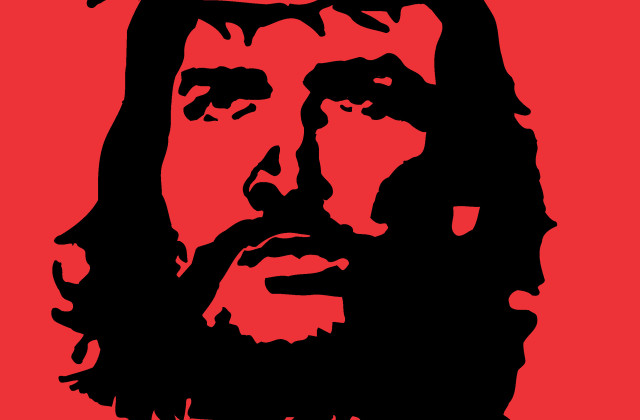
It is hard, especially in the world of politics, to find a word more powerful than revolution. Its ability to evoke emotion: nostalgia, terror, regret, hope is immense. It calls to our minds events like the birth of our nation, the great terror, global struggles against colonialism and other forms of economic oppression. It conjures images of great heroes and villains from history and people who cannot neatly fit into any of the above categories. Che Guevera, who you may know from his appearances on posters and t-shirts in college campuses, said of revolution “It is a labor bringing the hope of a better life to the enslaved and exploited masses.”. It makes sense that political forces in the USA would seek to use this word in order to tap into its power.

The most popular figure to do this recently is without a doubt Bernie Sanders. While his revolution is actually geared towards motivating participation in the current system rather than overthrowing it, the reforms he calls for would shake American Government and the austerity mindset which has controlled it since the days of Ronald Regan. It is an attempt at liberatory change, even if not in the traditional revolutionary sense. The word revolution also gets thrown around a lot by people on the right-wing of the political spectrum. Recently, a video interview featuring ‘Elizabeth from Knoxville’, a woman who participated in the Capital Insurrection, gained some popularity. In the video, she expresses surprise and dismay that she was sprayed with mace. When asked why she tried to enter the Capitol Building, she declares “We’re storming the Capitol — it’s a revolution!”. Here, the word revolution is used in an attempt not to create change, but to maintain what already is. Because of the mixed nature of the crowd at the Capitol that day, the specifics of what their revolution is about is incoherent, however, Trumpism, if it claims to be revolutionary at all, is a revolution which erases change and turns us back towards a past which is perceived as better or more pure than now. That is what it means to “Make America Great Again”.
In the Circle of Peacemakers for the last year, I too have been calling for the cultivation of a revolutionary spirit. It seems to me obvious that sincere identification with the poor and those who suffer requires the adoption of radical stances geared towards solving the long standing social issues which generate that suffering. It is a natural extension of the principle of doing unto others as I would have them do unto me. Additionally, it is the best way I know how to lift up and let shine the love of Christ which was given to me and lives in my heart. It is the only way, known to me at least, to reveal that light to people who have, with legitimate reason, dismissed the Christian faith as uninspiring and milquetoast if not straight reactionary and counter to their values. Because of its muddled nature, I have not explicitly used the word revolution or revolutionary, but given the power of those words to evoke feeling, perhaps that is a mistake. I am now beginning to feel that we as Christians should embrace this word, but if we do so, we must do so in a more authentic way then what has been seen up to this point in the USA. We need to work out specifically what revolution means to us. This essay will be an attempt to jump start this process.
The Church and Revolution
It may be surprising, given my desire to use this word and embrace revolutionary stances, but my take on revolution is actually a somewhat pessimistic one. Revolutions across history and space vary greatly. It is a real intellectual labor to analyze and compare and contrast them, but there is one thing that ties them together: failure. This is not to say that all revolutions end in failure or that all revolutionary activity is an exercise in futility, but failure is at their root. A revolution occurs because a system fails to meet the demands that are made of it by the people it rules over. Revolutionaries then are not people who start revolutions, only whole systems in their failure can provide the fuel for revolution, they are individuals or groups of individuals which engage the failure of a system. This can be seen in many revolutions throughout history.
In Russia, the final failure came February 1917 with the fall of the monarchy which led to the rise of bolsheviks and the final revolution in October of that same year. More recently, in Egypt, the failure of the Mobarak regime led to protests which facilitated its collapse, this then led to elections and a second wave of revolution which resulted in the military retaking power, this time without Mobarak. Two revolutions with wildly different outcomes, both rooted in and fueled by the failure of what came before. Revolution is not inherently good or progressive in any sense of the word; it is first and foremost a failure, a breakdown, a fall from grace. That is probably one reason why our more moderate brothers and sisters discuss and criticize revolutionary rhetoric. To seek revolution is to seek a chain reaction which may consume and destroy not just what you hate, but also what you love. These critics, however, err and over simplify when they start and stop with criticizing those who use revolutionary rhetoric. Just like oxygen on its own cannot create combustion without other elements to react to, revolutionary rhetoric itself is powerless absent a failed system. The real and perceived failure of a system generates revolutionary rhetoric and sentiment which then generates a feedback loop.This insight is useful, especially to Christians, because we have a close and personal relationship with failure.
As Christians, failure is also the inevitable beginning of our journey. It is our birth home, and if we are honest with ourselves, we often return there throughout our life journey with Christ. There are many ways in which the internal revolution which comes through Christ mirrors the revolutions of the outside world. As stated before, they are both propelled by failure, and a desire to transcend and transform said failure. They both involve, at their best, a profound shift in values and a leap into the unknown. Like in a revolution, our Christian journey may call us to undergo painful and potentially violent transformation. To quote Jesus in Matthew 5:29-30: “If your right eye causes you to sin, gouge it out and throw it away. It is better for you to lose one part of your body than for your whole body to be thrown into hell. And if your right hand causes you to sin, cut it off and throw it away. It is better for you to lose one part of your body than for your whole body to depart into hell.”. In its call to purge from ourselves what does not serve God, the Christian life can be ruthless and it’s not hard to see how it could be suited well to revolution.
Despite this, Christians, both recently in America and throughout history, often seem enamored with the current state of things to the point of being patently anti-revolutionary. Throughout the transition from feudalism to capitalism, it would have been impossible to find a more staunch opponent to positive land reforms for the peasantry then the church (which owned most of the land in many European countries). In modern times, Martin Luther King Jr. in his “Letter from Birmingham Jail” was heavily critical of the lukewarm stance of the church, specifically the white church, in relation to his struggle for basic human dignities and the end of American Apartide. Today, the Church in America, both liberal and conservative, is so hollowed out and possessed by the Spirit of American Exceptionalism and American Civil Religion that it has little room for any other kind of thinking. This was on full display for anyone who was able to watch Biden and Harris’s inaugural ceremonies earlier this week.
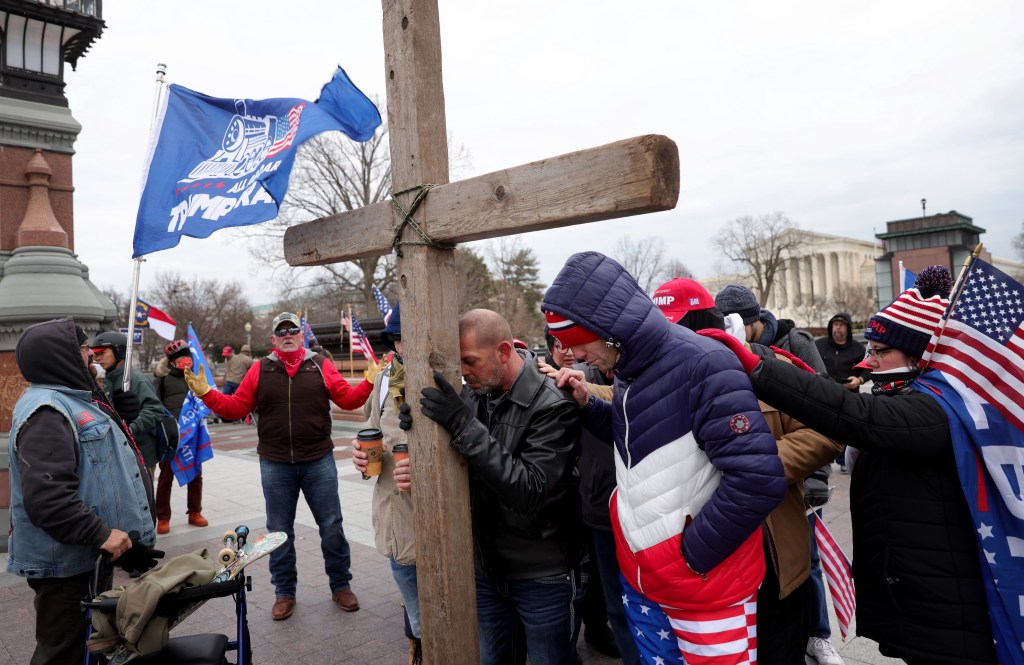
If their is a revolutionary spirit within the American Church, it appears, unfortunately, to be a primarily reactionary and nationalistic one. It is a twisted spirit born out of the cognitive dissonance created by our worship and identity with the state, and the stubborn facts of our daily lives which indicate that this worshipped God/State has sold us out. Why reaction and bigotry is a continuous tendency of the Church across time is an important question that deserves its own book. In this essay, it would be impossible to portray the Church fairly and accurately and in anything approaching its full depth and complexity. Due to this, it is enough here to say that this is a recurring tendency and constitutes a challenge to integrating the idea of positive revolutionary change into the faith.
Jesus and Revolutionary Sentiment in the Bible
This leaves us in a pretty disturbing situation. On one hand, we hold a faith that is almost inherently revolutionary, on the other, as keepers of that faith we are generally poor at externalizing that revolutionary potential in a positive way. One issue may be that, as a community, we seldom speak or think deeply on this topic. Perhaps, in the adsense of a definitive biblical declaration by Jesus we feel content to be led by the common sense of our current time. This is tempting, but ultimately bad practice for the Church, as today’s common sense can become tomorrow’s shame . Jesus cannot directly speak to the specific political issues of our time, but as members of his body, we have a responsibility to ask the hard questions and to seek the wisdom of the Spirit which he gave us. While gospels never utter the word revolution, I think there are some things we can derive from scripture to at least get us started.
I cannot think of anything that captures the revolutionary spirit of Jesus’s teachings more than his declaration to the apostles in Matthew Chapter 10: 34-39.
“Do not suppose that I have come to bring peace to the earth. I did not come to bring peace, but a sword. For I have come to turn a man against his father, a daughter against her mother, a daughter-in-law against her mother-in-law, a man’s enemies will be the members of his own household. Anyone who loves their father or mother more than me is not worthy of me; anyone who loves their son or daughter more than me is not worthy of me. Whoever does not take up their cross and follow me is not worthy of me. Whoever finds their life will lose it, and whoever loses their life for my sake will find it.”
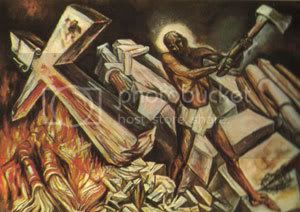
Here we have a clear mandate to prioritize the faith and our journey with Jesus Christ over the prevailing hierarchical social relations in our world. The call is similar to the message we discussed above in Mathew Chapter 5, but it extends that call from the personal to the interpersonal. Jesus’s teachings provide us a critical lens, a kind of sword, through which we can analyze and chop up not just our internal world but also the social relations which we are told define us: son, father, mother, daughter, enemy, friend. This call is actually much more radical, profound, and total in its nature then most earthly revolutionary calls we experience. It is not a call just for institutional change, but for the reworking of the self and everything connected to it.
Through the above scripture, we begin to see what we may accomplish by incorporating the concept of revolution into our faith. We see the justification for doing so, and the foundation that Jesus himself has laid out, but what does this specifically mean for the Church in America? In part two of this essay, to be released in one week, we will begin to explore how we can build a revolutionary Church in the here and now. What are the political and cultural obstacles we face? How do we extend grace through revolution? I look forward to exploring this with you. As always, I hope my writings can serve to inspire conversation and transformation within the Community of the Spirit.
With Love and Hope,
Rand W.

What does it mean to say that Christ is King
As challenges and lawsuits continue to fly in the aftermath of this year’s presidential elections, the call of Christ the King Sunday, the last Sunday in the liturgical calendar before Advent, seems especially relevant. It is important to stay grounded in the truth of Christ’s sovereignty over the world as different political factions inundate us with pleas for the allegiance of our hearts and minds. This Sunday, we are reminded that there is a deeper truth then the narratives pushed by institutions and their talking-heads for their personal convenience, but as we acknowledge this, we also need to examine ourselves. As we profess Christ to be King, we need to think deeply about what that really means so that we can pursue that truth with sincerity.
This self analysis is especially important in the hyper-propagandized world we live in today. Christ in his wisdom warned us that it was impossible to serve two masters, so it is of dire importance for us as Christians to to try to sort out whose banner we are really marching under. How can we cling to the truth of Christ in a world that seems to have given up on the concept of truth entirely? What is the proper place of earthly powers, and how can we make sure they are not overstepping their bounds? To approach these problems, this essay will focus on how we view “the truth” and how it seems to function in politics.
The Post-Truth world and the Battle Ground of our Mind
One of the most pressing uses of power by forces in this world is the ability to craft narratives and place them on the mantle of “the truth”. This tendency of earthly authorities to play fast and loose with the concept of truth has been around a long time, and is alluded to by Pontius Pilate when he asks Jesus “what is truth”. To the Empire and its lackeys, truth has always been a matter of what you can take and defend. This has been highlighted in recent years by President Trump due to the degree to which he is comfortable asserting narratives in the face of evidence to the contrary, but Democrats, the companies we work at, and even blog writers at Circle of Peacemakers do this. Indeed, much of what passes for politics in the United States these days is a tug-of-war between various forces as they try to crown their narratives with the crown of “the Truth”.
The primary battleground for “the truth” in this post-truth age is your mind. The average person in the USA is one of the most propagandized subjects in all of human history. When you take time to consider all of the competing narratives and truth claims banging around in our heads, it’s not hard to see how different Americans increasingly seem to be living in entirely different realities. The post-truth era calls us all to live in our own private worlds, and as we more deeply withdraw the anxiety, cognitive dissonance, and polarization increases. We are like musicians in a symphony surrounded by dozens of conductors, all wildly flailing for our attention. Even if the individual melodies we play are pretty, the dissonance created as these melodies clash against each other in the air is ugly, and they drown out the work of the conductor who assembled the symphony in the first place.Where does this leave us? The truth is not encompassed by anyone position or conductor, and it does not lie in some illusory middle ground between these positions. How then can we align ourselves with the original conductor: Jesus Christ?
Part of the problem is that the truth given to us by Christ is quiet. Its value is not increased or decreased by passionate pleas to its validity, and it has nothing to gain by trying to be the loudest voice in the room. The human mind, however, tends to gravitate towards what is bombarding its senses. Overtime, we tend to forget a real Truth exists outside of this bombardment of truths, but we cannot allow this overload to hypnotize us. To break out of the post-truth battle ground is to rail against the apparent, the spectacle of the symphony, and to quiet ourselves and go deeper. It is to assert that, despite the many dissonant narratives being played in our ear, there is an actual truth. It is to assert that there is a truth and then to approach that truth with a spirit of humility. The journey for truth is a journey for transformation, not a journey for attainment and control. It is not possible to say what is at the end of that path, but it is when we begin this journey, with humility and the willingness to question and crucify our claims on the truth, that we declare that Christ is King!
A warning Against Simplification and Aloofness
While it is important to stay grounded in the search for a truth deeper than that offered by the political sphere, this should be in no ways seen as a call to disengage from political narratives and pretend that we are above the fray. It should also not be seen as a statement about how all narratives are equally untrue. The rejection of the political in faith is nothing less then the rejection of ourselves, and churches have crafted theologies to justify keeping their heads down in times of injustice for too long. Instead, we should critically analyze political positions to see which ones best reflect the values of our Gospel as we understand it, and again, we need to do so with humility and the willingness to be transformed by this process. It is possible, and maybe likely, that a great deal of what we hold to be true will have to be sacrificed to God in our pursuit of his Kingdom.
A Meditation on Leaders: the Shields of the People
In closing, let’s meditate on the words of psalm 47. Let us clap and sing in the realization that Christ is King. As leaders, we are not to try to assert our truth above God’s, but rather we are to act as shields against forces that seek to exploit and victimize the people. Let us not speak out for our own benefit, but for the defense of the poor and those under attack. Lets remember Matthew 20:26, “whoever wants to be great among you must be your servant.”.
Clap your hands, all you nations;
shout to God with cries of joy.
For the Lord Most High is awesome,
the great King over all the earth.
He subdued nations under us,
peoples under our feet.
He chose our inheritance for us,
the pride of Jacob, whom he loved.
God has ascended amid shouts of joy,
the Lord amid the sounding of trumpets.
Sing praises to God, sing praises;
sing praises to our King, sing praises.
For God is the King of all the earth;
sing to him a psalm of praise.
God reigns over the nations;
God is seated on his holy throne.
The nobles of the nations assemble
as the people of the God of Abraham,
for the shields of the earth belong to God;
he is greatly exalted.

First, I would like to start by thanking Marsha Lewis and Anthony Miller who were able to make it out to the camp to help clean last week. By helping to maintain safety and a decent standard of living at this camp, they used their bodies and time to reflect the love shown to us by our Lord Jesus Christ and followed in his footsteps by offering leadership through service to the poor and the vulnerable. According to the epistle of James chapter 1:22-27, God the Father sees the manifestation of the word through our actions as the truest and most pure expression of our faith.
Since the last update, another deadline for vacating the park has come and gone. With negotiations still at a standstill, the camp continues to exist but with no clear path towards its goal of meaningful reforms within the Philadelphia Housing Authority (PHA). Mayor Kenny and other officials are playing their cards close to their chest and the camp doesn’t have the support needed to force the government’s hand on any issue. This stalemate, along with what seems to be a growing number or residents, has led to a tense situation within the camp.

As the days begin to cool, it remains unclear what next steps are, but the camp continues to maintain a level of safety, dignity, and community that would otherwise be impossible for people living alone on the streets or even in shelters in some cases. Continued donations mean that free food, clothing, and showering facilities are being maintained. Our sanitation efforts, supplementing the residents own cleaning measures and the above mentioned factors, mean that residents can enjoy a decent standard of living as the situation continues to develop. This is a necessary condition for the just resolution of this conflict. If you are interested in helping with our cleaning efforts, please reach out to cohpeacemakers@gmail.com.
Remembering the Occupation of St. Edwards Church
As my involvement in the camp grows, I find a path unfolding before me that I believe has been laid out by God. This path is leading me to new people and places in exciting ways I would not have expected. Yesterday, it led me to a commemoration of the 25th anniversary of the Occupation of St. Edwards Church. I listened to the personal accounts of people whose lives were changed by that action. I heard about how they created holy ground there with homeless families and students from Eastern University. I heard of the horror and violence of poverty and the hope that community can bring. It was a touching ceremony that culminated in the start of a new occupation of that holy ground by families who are in need of shelter.

I wish I could give more hopeful news on this specific situation, but I was told that this new tent encampment was shut down by the authorities early this morning between 12:30 and 3:00 AM. These new families were expelled and Cheri Honkala, an activist with the Poor People’s Army, was arrested. I talked to Cheri shortly after her release. She told me that the scene last night was brutal, and while she still seemed shaken by the experience, she stated that they would continue to move to house the expelled families in need.
Having just met Cheri the day before, this experience has given me a new appreciation for those who really are living the spirit of nonviolent resistance we are trying to foster with the Circle of Peacemakers. It brought to mind a quote from famous peace activist and fellow brother in Christ Daniel Berrigan: “There is no peace because there are no peacemakers. There are no makers of peace because the making of peace is at least as costly as the making of war—at least as exigent, at least as disruptive, at least as liable to bring disgrace and prison and death in its wake.”. This quote from Dan is convincing. If we are to create just results for the poor of Philadelphia, we need more peacemakers.
Addressing Community Questions and concerns about the Camp
Besides the personal cost that building a more peaceful world can inflict, our current situation leaves us bombarded by contradictory information. This bombardment makes it hard to sort out the truth and can serve to diminish our resolve. Over the past week, I have received a number of questions about the value of the Camp at the Parkway and the usefulness of efforts to sustain it. Below I have a collection of some of these questions along with my best attempts to address them. Perhaps these answers will resonate with you. In any event, I hope to continue dialog like this in the future.
Finally, I would say that the City has no safe or humane way of ending this encampment. The CDC has advised against the destruction of the camp. The camp, even if it isn’t ideal, has also become a hub of resources and there is a good chance that people will die if this support is suddenly destroyed. If it doesn’t happen directly due to the violence that would be needed to destroy the camp, it will happen due to the inadequate systems Philadelphia has in place. In my view, working for a nonviolent solution to this conflict means that the camp has to be kept as clean and safe as possible. Camp residents deserve that just as much as any of us do. It is my hope the city will see the humanity of the situation and reconsider its current tactic of stonewalling the organizers.


(The Parkway Camp Kitchen pictured above served as a drop off point for our supplies and is a lively hub of community activity)
Supply Drive Results and Thanks
Last week, Circle of Peacemakers and a few allies were able to run a successful supply drive for the Benjamin Franklin Parkway Camp in Philadelphia. It was heartwarming and inspiring to be at the center of that effort, and to see, in real time, all the support coming in. It called to mind verse 27 from James chapter 1: “Religion that God our Father accepts as pure and faultless is this: to look after orphans and widows in their distress and to keep oneself from being polluted by the world.”. When we manifest God’s love on earth through acts of solidarity, we are not just hearers of the Word but doers as well.
In just one week, we were able to raise just shy of $400.00 in donations with an additional several hundred dollars worth of camping supplies and food. The money was used to fund shopping trips and all the supplies were gathered at 2007 Frankford Ave. On Wednesday August 12th, the gathered supplies were loaded up on a truck and taken directly to the camp where they were received with much appreciation.

I would like to take a moment to thank everyone who expressed their solidarity through donations. I want you to know that you made a difference in the quality of life for people who are struggling to make our city a more just place. Having been at the camp, I can tell you that Jesus has a tent there. What you have done for his comrades at the camp you have done also for him. I would like to especially thank the organizers : Mable Bakali, Rob Anstett, Kristen Snow, and Kipsy Wright. For some, it was their first dip into organizing and they all did brilliantly.
The Status of the Camp and its Conflict with the City Government
The camp itself has a general aura of lively controlled chaos, especially in the kitchen. There is a lot of need, but also a lot being done to meet that need. It is by no means a utopian project, but there is tangible transformation happening. That transformation is happening through the formation of a community with a common focus and through the realization of the empowerment that such a community can bring. Through the camp, the disparate voices of the disenfranchised have coalesced into a joyful noise with the ability to challenge city government and its uneven notion of development. I felt that energy tangibly when I visited the camp to drop off supplies. I felt it again when I stood with them earlier this week as the city stepped up rhetoric threatening to crush this new community.
The city issued a notice on Monday August 17th giving the camp residents only 24 hours to vacate. The Mayor said that negotiations had stalled due to the shifting demands of the organizers and that rising complaints by residents in the surrounding neighborhoods prompted the action. This notice resulted in a lawsuit and several activist groups converging on the site of the camp on Tuesday morning to defend the camp.

I was there early in the morning of August 18th to lend support and witness the events that were set to unfold. The energy was tense in anticipation of what surely would become a violent confrontation should the city move to enforce the notice it issued the day before. Camp residents and Black Block style anarchist groups had set up makeshift barricades. Small security groups were posted along the perimeter of the park communicating with each other via radio. Other groups wielded makeshift shields made of whatever materials could be gathered. Curious residents and news organizations gathered at a distance. The constant buzz of helicopters overhead added to the tense atmosphere. Would this showing be enough to deter the city from confrontation?

Despite the tense situation on the perimeter, life seemed to be continuing as normal for many residents on the inside. Conditions seemed sanitary. Organizers moved through the camp distributing facemasks. Friends joked with one another. One woman began blasting music, and not too far from that, drumming could be heard. People chanted camp slogans in unison. By the afternoon, it seemed clear that the city’s bluff had been called.
Final Thoughts and a Call to Action
As of now, the Parkway Camp remains. A new hopeful community full of contradictions and struggles the same as any. While city government has backed off, the eventual destruction of the camp still looms in the distance. The inhumanity of rigid government bureaucracy seems unwilling to consider bending to the most radical demands of organizers. As events unfold, we should be skeptical of narratives which paint organizers as unreasonable in a way that shifts responsibility for outcomes away from the Philadelphia City Government. Arguments about the camps sustainability, while true on some level, will be used to save face while stifling progress towards a just outcome.
In the end, the camp is not a solution but a mirror which we must use to look at ourselves. The Pharisees of Philadelphia want a city that looks clean on the outside to conceal its internal corruption. The Parkway Camp is a blemish on the outside of their cup and they want to remove it. While the camp’s death is inevitable, the kind of death it faces is not and our actions may have a role to play. Will the camp’s cocoon burst and point us towards a future where such things aren’t necessary, or will it become a tombstone around our necks, a testament to the indifference of our city’s leadership?
Whatever may happen, Circle of Peacemakers continues to seek positive involvement that lifts up the human spirit and deepens our bonds of solidarity. With an upcoming court hearing on Tuesday the 25th, there is still much that can be done. We will be holding a meeting this Friday the 21st at 7:30 PM, and this topic will be up for discussion. Reach out to me at randw87@gmail.com if further work around the camp interests you or if you would like to be on the Circle of Peacemaker mailing list. With God’s help, the impossible becomes possible, and we take hope in the promises and love of our Lord Jesus Christ. Through this struggle we hope to extend that hope all.
Writing and photography by Rand Williamson

(The remains of Our Lady of Nagasaki pulled from the ruins of Nagasaki. Its ghostly hallowed out appearance serves as a warning about the use and development of nuclear weapons)
The Divorce of Matter and Spirit
Father, Son, Holy Spirit
Protons, Neutrons, Electrons
on earth as in heaven
what God hath put together
let no man tear asunder
The Bomb: A Dark God for the Modern age
On August 6th, 1945, the USA ushered in the nuclear age with the bombing o Hiroshima. An act that, as noted by historian Howard Zinn, was utterly cruel and strategically unnecessary(1). Then, on August 9th, another bomb fell on Nagasaki. The particle remains of its buildings and its people would serve as an example to the enemies of the USA and become part of the foundation of its new global empire.
The first nuclear test took place less then a month earlier on July 16, 1945 in White Sands New Mexico. It was called Trinity. The bomb has always had a quasi-religious significance, especially to those who would use it to secure their power in the coming age. We now had the power of the sun at our disposal. The power to invert the furnace of creation for our own destructive ends. President Harry S. Truman described the bomb as a “powerful weapon in the arsenal of the righteous”. The atomic bomb was a new man made god for the modern age that promised great influence to those who could master it, but what fruits did this new god bare? Like most Gods made by men, the atomic bomb turned out to be a cruel demiurge, and instead of bringing an age of security, it ushered in a new world order of paranoia and anarchy. Today we still cower in its shadow, the only thing it has assured is our mutual destruction.
The above image of Our Lady of Nagasaki, which was pulled out of the ruins of Nagasaki’s Immaculate Conception Cathedral, serves as a warning to all and to Christians particularly. These weapons injure creation and the true God who birthed it. They are an affront to the God who longs to keep us whole like a mother hen that gathers its brood under her wing. If we continue to pursue them, we risk becoming mutilated, hollowed out, and filled with darkness like the image of our beloved saviors mother above.
A Prayer for the End of Nuclear weapons
God of Love
True maker God who holds all of creation to her breast
Who sustains us and calls us to unity
You are the floor on which we stand
As we call on you, call us to your peace
Call us away from the forces that divide us
That would split us atom from atom
Call us to live under your authority
Provide us with wisdom
With the love and security to bend our swords into plowshares
Enlighten our eyes lord
to see the true value of human life
Strengthen our hands
To lift up your spirit and dispel the false Gods created by men.
Lord, it is your power alone that can save!
We no longer put our trust in weapons of war
Soften the hearts of our leaders
So we may avoid the coming time of trial
Amen
Have a WordPress.com account? Log in now.

