
Revolutionary Talk in Recent Politic: What Does it Mean?
It is hard, especially in the world of politics, to find a word more powerful than revolution. Its ability to evoke emotion: nostalgia, terror, regret, hope is immense. It calls to our minds events like the birth of our nation, the great terror, global struggles against colonialism and other forms of economic oppression. It conjures images of great heroes and villains from history and people who cannot neatly fit into any of the above categories. Che Guevera, who you may know from his appearances on posters and t-shirts in college campuses, said of revolution “It is a labor bringing the hope of a better life to the enslaved and exploited masses.”. It makes sense that political forces in the USA would seek to use this word in order to tap into its power.

The most popular figure to do this recently is without a doubt Bernie Sanders. While his revolution is actually geared towards motivating participation in the current system rather than overthrowing it, the reforms he calls for would shake American Government and the austerity mindset which has controlled it since the days of Ronald Regan. It is an attempt at liberatory change, even if not in the traditional revolutionary sense. The word revolution also gets thrown around a lot by people on the right-wing of the political spectrum. Recently, a video interview featuring ‘Elizabeth from Knoxville’, a woman who participated in the Capital Insurrection, gained some popularity. In the video, she expresses surprise and dismay that she was sprayed with mace. When asked why she tried to enter the Capitol Building, she declares “We’re storming the Capitol — it’s a revolution!”. Here, the word revolution is used in an attempt not to create change, but to maintain what already is. Because of the mixed nature of the crowd at the Capitol that day, the specifics of what their revolution is about is incoherent, however, Trumpism, if it claims to be revolutionary at all, is a revolution which erases change and turns us back towards a past which is perceived as better or more pure than now. That is what it means to “Make America Great Again”.
In the Circle of Peacemakers for the last year, I too have been calling for the cultivation of a revolutionary spirit. It seems to me obvious that sincere identification with the poor and those who suffer requires the adoption of radical stances geared towards solving the long standing social issues which generate that suffering. It is a natural extension of the principle of doing unto others as I would have them do unto me. Additionally, it is the best way I know how to lift up and let shine the love of Christ which was given to me and lives in my heart. It is the only way, known to me at least, to reveal that light to people who have, with legitimate reason, dismissed the Christian faith as uninspiring and milquetoast if not straight reactionary and counter to their values. Because of its muddled nature, I have not explicitly used the word revolution or revolutionary, but given the power of those words to evoke feeling, perhaps that is a mistake. I am now beginning to feel that we as Christians should embrace this word, but if we do so, we must do so in a more authentic way then what has been seen up to this point in the USA. We need to work out specifically what revolution means to us. This essay will be an attempt to jump start this process.
The Church and Revolution
It may be surprising, given my desire to use this word and embrace revolutionary stances, but my take on revolution is actually a somewhat pessimistic one. Revolutions across history and space vary greatly. It is a real intellectual labor to analyze and compare and contrast them, but there is one thing that ties them together: failure. This is not to say that all revolutions end in failure or that all revolutionary activity is an exercise in futility, but failure is at their root. A revolution occurs because a system fails to meet the demands that are made of it by the people it rules over. Revolutionaries then are not people who start revolutions, only whole systems in their failure can provide the fuel for revolution, they are individuals or groups of individuals which engage the failure of a system. This can be seen in many revolutions throughout history.
In Russia, the final failure came February 1917 with the fall of the monarchy which led to the rise of bolsheviks and the final revolution in October of that same year. More recently, in Egypt, the failure of the Mobarak regime led to protests which facilitated its collapse, this then led to elections and a second wave of revolution which resulted in the military retaking power, this time without Mobarak. Two revolutions with wildly different outcomes, both rooted in and fueled by the failure of what came before. Revolution is not inherently good or progressive in any sense of the word; it is first and foremost a failure, a breakdown, a fall from grace. That is probably one reason why our more moderate brothers and sisters discuss and criticize revolutionary rhetoric. To seek revolution is to seek a chain reaction which may consume and destroy not just what you hate, but also what you love. These critics, however, err and over simplify when they start and stop with criticizing those who use revolutionary rhetoric. Just like oxygen on its own cannot create combustion without other elements to react to, revolutionary rhetoric itself is powerless absent a failed system. The real and perceived failure of a system generates revolutionary rhetoric and sentiment which then generates a feedback loop.This insight is useful, especially to Christians, because we have a close and personal relationship with failure.
As Christians, failure is also the inevitable beginning of our journey. It is our birth home, and if we are honest with ourselves, we often return there throughout our life journey with Christ. There are many ways in which the internal revolution which comes through Christ mirrors the revolutions of the outside world. As stated before, they are both propelled by failure, and a desire to transcend and transform said failure. They both involve, at their best, a profound shift in values and a leap into the unknown. Like in a revolution, our Christian journey may call us to undergo painful and potentially violent transformation. To quote Jesus in Matthew 5:29-30: “If your right eye causes you to sin, gouge it out and throw it away. It is better for you to lose one part of your body than for your whole body to be thrown into hell. And if your right hand causes you to sin, cut it off and throw it away. It is better for you to lose one part of your body than for your whole body to depart into hell.”. In its call to purge from ourselves what does not serve God, the Christian life can be ruthless and it’s not hard to see how it could be suited well to revolution.
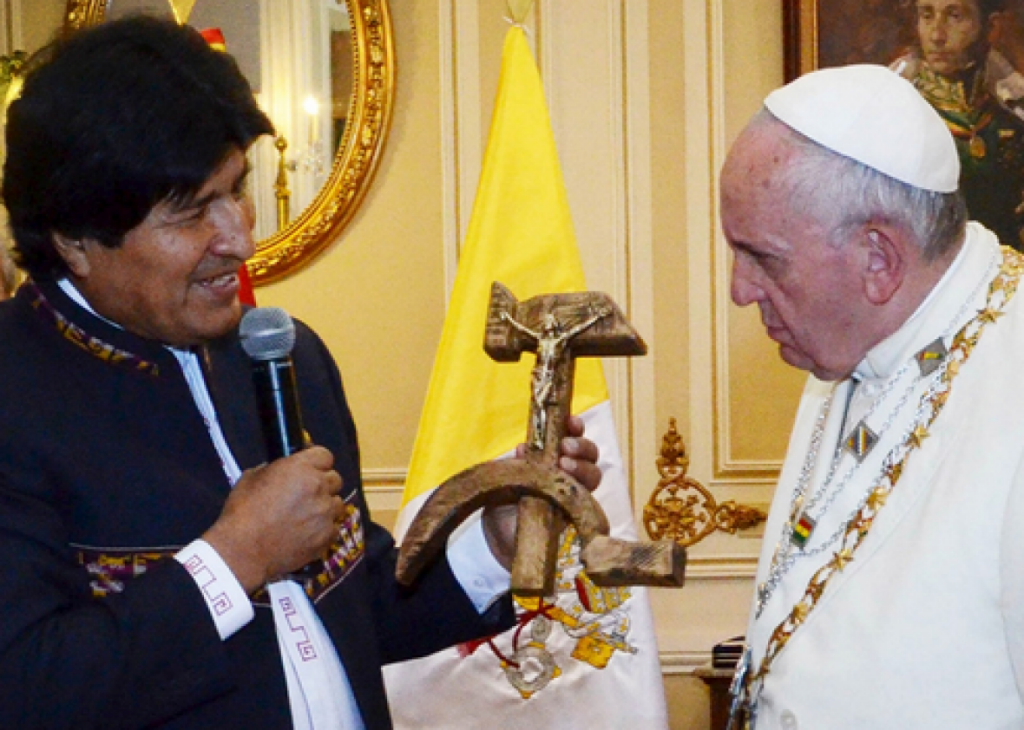
Despite this, Christians, both recently in America and throughout history, often seem enamored with the current state of things to the point of being patently anti-revolutionary. Throughout the transition from feudalism to capitalism, it would have been impossible to find a more staunch opponent to positive land reforms for the peasantry then the church (which owned most of the land in many European countries). In modern times, Martin Luther King Jr. in his “Letter from Birmingham Jail” was heavily critical of the lukewarm stance of the church, specifically the white church, in relation to his struggle for basic human dignities and the end of American Apartide. Today, the Church in America, both liberal and conservative, is so hollowed out and possessed by the Spirit of American Exceptionalism and American Civil Religion that it has little room for any other kind of thinking. This was on full display for anyone who was able to watch Biden and Harris’s inaugural ceremonies earlier this week.

If their is a revolutionary spirit within the American Church, it appears, unfortunately, to be a primarily reactionary and nationalistic one. It is a twisted spirit born out of the cognitive dissonance created by our worship and identity with the state, and the stubborn facts of our daily lives which indicate that this worshipped God/State has sold us out. Why reaction and bigotry is a continuous tendency of the Church across time is an important question that deserves its own book. In this essay, it would be impossible to portray the Church fairly and accurately and in anything approaching its full depth and complexity. Due to this, it is enough here to say that this is a recurring tendency and constitutes a challenge to integrating the idea of positive revolutionary change into the faith.
Jesus and Revolutionary Sentiment in the Bible
This leaves us in a pretty disturbing situation. On one hand, we hold a faith that is almost inherently revolutionary, on the other, as keepers of that faith we are generally poor at externalizing that revolutionary potential in a positive way. One issue may be that, as a community, we seldom speak or think deeply on this topic. Perhaps, in the adsense of a definitive biblical declaration by Jesus we feel content to be led by the common sense of our current time. This is tempting, but ultimately bad practice for the Church, as today’s common sense can become tomorrow’s shame . Jesus cannot directly speak to the specific political issues of our time, but as members of his body, we have a responsibility to ask the hard questions and to seek the wisdom of the Spirit which he gave us. While gospels never utter the word revolution, I think there are some things we can derive from scripture to at least get us started.
I cannot think of anything that captures the revolutionary spirit of Jesus’s teachings more than his declaration to the apostles in Matthew Chapter 10: 34-39.
“Do not suppose that I have come to bring peace to the earth. I did not come to bring peace, but a sword. For I have come to turn a man against his father, a daughter against her mother, a daughter-in-law against her mother-in-law, a man’s enemies will be the members of his own household. Anyone who loves their father or mother more than me is not worthy of me; anyone who loves their son or daughter more than me is not worthy of me. Whoever does not take up their cross and follow me is not worthy of me. Whoever finds their life will lose it, and whoever loses their life for my sake will find it.”
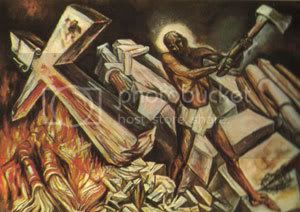
his Cross,” 1943
Here we have a clear mandate to prioritize the faith and our journey with Jesus Christ over the prevailing hierarchical social relations in our world. The call is similar to the message we discussed above in Mathew Chapter 5, but it extends that call from the personal to the interpersonal. Jesus’s teachings provide us a critical lens, a kind of sword, through which we can analyze and chop up not just our internal world but also the social relations which we are told define us: son, father, mother, daughter, enemy, friend. This call is actually much more radical, profound, and total in its nature then most earthly revolutionary calls we experience. It is not a call just for institutional change, but for the reworking of the self and everything connected to it.
Through the above scripture, we begin to see what we may accomplish by incorporating the concept of revolution into our faith. We see the justification for doing so, and the foundation that Jesus himself has laid out, but what does this specifically mean for the Church in America? In part two of this essay, to be released in one week, we will begin to explore how we can build a revolutionary Church in the here and now. What are the political and cultural obstacles we face? How do we extend grace through revolution? I look forward to exploring this with you. As always, I hope my writings can serve to inspire conversation and transformation within the Community of the Spirit.
With Love and Hope,
Rand W.
 Circle of Peacemakers
The Jesus Love Revolution has been a long time growing, but still feels fresh for this generation. Thanks for being a revolutionary and for inviting others into a transformative walk with the Holy Spirit.
LikeLike